Why Stiffness Matters More Than Density
SERIES II — GRAVITY & RELATIVITY
Stress, Not Curvature
When gravity is discussed in mechanical terms, a natural instinct is to focus on density. After all, mass density feels like the obvious quantity to change if matter is present. Many alternative gravity models take exactly this approach: more mass, higher density, stronger gravity.
The problem is that density alone rarely controls how forces and waves behave.
In real materials, it is stiffness—not density—that usually dominates the response.
This post explains why that distinction matters, and why gravity behaves like a stiffness-gradient phenomenon rather than a density-gradient one.
Density and Stiffness Are Not the Same Thing
Let’s clarify terms carefully.
- Density describes how much material occupies a given volume.
- Stiffness describes how strongly that material resists deformation.
They are related, but not interchangeable.
Two materials can have the same density and wildly different stiffness.
Foam and steel are the obvious example.
In mechanics, it is stiffness that determines:
- how stress propagates,
- how waves bend,
- how energy is stored under strain.
Density mostly sets inertia.
A Mechanical Rule of Thumb
In elastic media, wave speed depends on a ratio:
wave speed ∝ √(stiffness / density)
This applies to:
- seismic waves in rock,
- shear waves in metals,
- vibrations in engineered structures.
Changing density alone tends to produce modest effects.
Changing stiffness—even slightly—can dominate behavior.
This is a well-established experimental fact, not a theoretical preference.
Why Density-Only Gravity Models Struggle
If gravity were driven primarily by increased density near mass:
- regions around matter would behave like compressed material,
- pressure would rise,
- repulsion would be expected unless additional assumptions are added.
This is mechanically awkward.
Attraction in materials does not arise from compression.
It arises from tension and compliance gradients.
Put simply:
- compressed regions push outward,
- softened regions pull inward.
This is why stiffness gradients are so effective at guiding motion.
Stiffness Gradients Create Attraction
In a medium where stiffness varies with position:
- waves slow down in softer regions,
- trajectories bend toward reduced stiffness,
- energy flows inward along gradients.
This is true in acoustics, optics, and elasticity.
From a mechanical standpoint, gravity behaves exactly like this:
- everything accelerates toward regions where the medium responds more easily to deformation.
That is not how density behaves—but it is precisely how stiffness behaves.
Connecting to Relativity (Carefully)
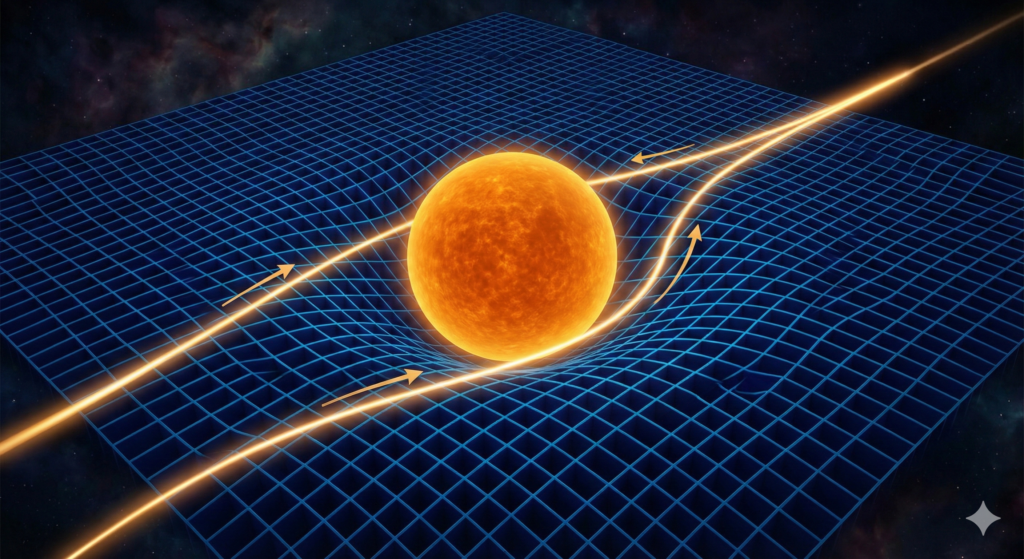
In the weak-field limit of General Relativity, the gravitational field around a mass produces the well-known Karl Schwarzschild result: light bends, clocks slow, and orbits precess in a specific, tightly constrained way.
What matters here is not the mathematical form, but the type of behavior:
- signal speeds vary with position,
- trajectories refract,
- effects scale smoothly and universally.
These are hallmarks of a graded material response, not of a density pile-up.
A stiffness-dominated medium reproduces these behaviors naturally.
A Constitutive Insight
When the vacuum is treated as a medium under gravitational stress:
- both density and stiffness may change,
- but stiffness must change more strongly than density.
This asymmetry is not arbitrary. It is the only way to produce:
- attraction rather than repulsion,
- correct light bending,
- correct orbital behavior,
- and consistency across different phenomena.
Gravity, in this view, is not “caused” by mass increasing density—it is caused by mass softening the medium’s response.
A Familiar Materials Analogy
Engineers see this behavior constantly.
- Soft inclusions in solids act as mechanical sinks.
- Stress concentrates where stiffness is reduced.
- Motion and energy flow toward compliant regions.
No new forces are required. The material does the work.
Treating gravity as stiffness-dominated places it squarely within this familiar mechanical category.
What This Does—and Does Not—Claim
This post does not claim:
- that density plays no role in gravity,
- that spacetime geometry is incorrect,
- or that matter “removes stiffness” in a literal engineering sense.
It does claim:
- that stiffness gradients are the dominant mechanical driver,
- that attraction follows naturally from compliance,
- and that density-only explanations are mechanically incomplete.
Why This Matters Going Forward
Once stiffness is recognized as the primary player:
- gravity aligns with elasticity rather than compression,
- geometry becomes a bookkeeping device,
- and anomalies become easier to diagnose.
In the next post, we examine a consequence of this idea that is often misunderstood—and frequently sensationalized.
Next:
→ The Speed of Light Is the Speed of Sound