
Walter Russell Was Asking the Right Question
SERIES III — ATOMIC STRUCTURE & HARMONICS
Matter as Standing Wave Geometry
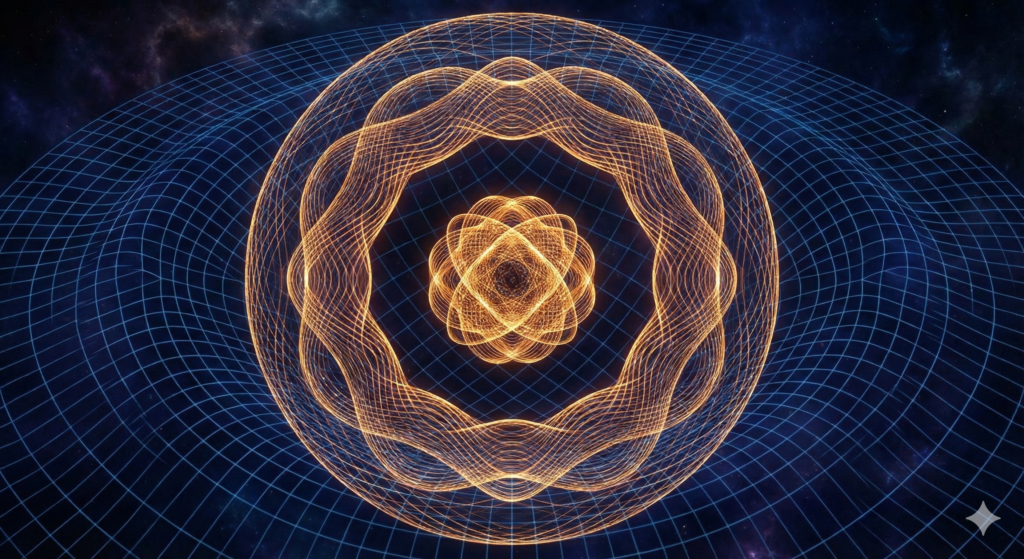
Walter Russell is often introduced as a cautionary tale—an outsider whose ideas drifted too far from accepted physics. His periodic tables, filled with spirals, octaves, and rhythmic language, are frequently dismissed as metaphysical rather than scientific.
That dismissal misses something important.
This post is not an endorsement of Russell’s conclusions. It is an acknowledgment that he was asking a question modern physics largely stopped asking:
Why does matter organize into repeating, octave-like structures at all?
Pattern Recognition vs. Explanation
Science advances through two distinct activities:
- recognizing patterns, and
- explaining mechanisms.
Russell excelled at the first.
He struggled with the second.
His periodic tables emphasized:
- repetition across scales,
- symmetry about central elements,
- octave relationships between chemical families.
What he lacked were the mechanical tools to justify those patterns. Without a substrate, the patterns floated free—inviting metaphysical interpretation.
That does not make the patterns wrong. It makes them incomplete.
The Octave Question
Russell repeatedly emphasized octaves in the periodic table. This choice was not arbitrary.
In physics, octave relationships appear whenever:
- systems support standing waves,
- closure conditions repeat across scales,
- higher modes contain embedded structure from lower ones.
Octaves are not musical artifacts. They are signatures of scale-invariant resonance.
Modern quantum mechanics acknowledges discrete energy levels, but it rarely asks why the spacing and grouping exhibit such regularity across very different elements.
Russell asked that question explicitly.
Central Elements and Symmetry
One of Russell’s most striking claims was that the periodic table is symmetric about certain central elements, rather than progressing monotonically outward.
From a particle-counting perspective, this is puzzling.
From a wave perspective, it is natural.
Standing-wave systems often exhibit:
- nodes of minimal coupling,
- antinodes of maximal interaction,
- symmetry about equilibrium points.
Seen mechanically, “central” elements are not mystical—they are balance points in a resonance hierarchy.
Where Russell Went Too Far
Russell lacked access to:
- modern quantum data,
- continuum mechanics,
- defect theory,
- experimental constraints on atomic structure.
As a result, he filled explanatory gaps with cosmological narratives and absolute claims that cannot be tested or defended today.
This blog deliberately does not follow him there.
What it retains is his core intuition:
- periodicity reflects wave structure,
- matter is organized by resonance,
- and the table is not an arbitrary ledger.
Reframing Russell Mechanically
When Russell’s ideas are reframed using modern concepts:
- octaves become mode families,
- symmetry becomes boundary condition closure,
- centrality becomes minimum coupling,
- repetition becomes scale embedding.
Nothing supernatural is required.
The vacuum-as-medium framework supplies what Russell did not have: a physical substrate capable of supporting standing-wave defects.
Credit Without Canonization
It is appropriate to credit Walter Russell for noticing patterns others ignored. It is not appropriate to treat him as a suppressed authority or prophetic figure.
Insight does not require infallibility.
Physics progresses by salvaging the useful questions and discarding the rest.
Why This Matters
By rehabilitating the question rather than the doctrine, we gain:
- a physically grounded way to discuss periodicity,
- freedom from metaphysical baggage,
- and a bridge between empirical chemistry and mechanical structure.
Russell’s work becomes a historical hint, not a foundation.
In the next post, we move from pattern to mechanism and show how atomic shell closure can be understood as a mechanical node—a point of minimum coupling in a standing-wave system.
Next:
→ Atomic Shell Closure as a Mechanical Node