Electromagnetism as Stress–Flow, Not Force
SERIES IV — ELECTROMAGNETISM, MODES & CONSTRAINTS
Fields as Stress–Flow
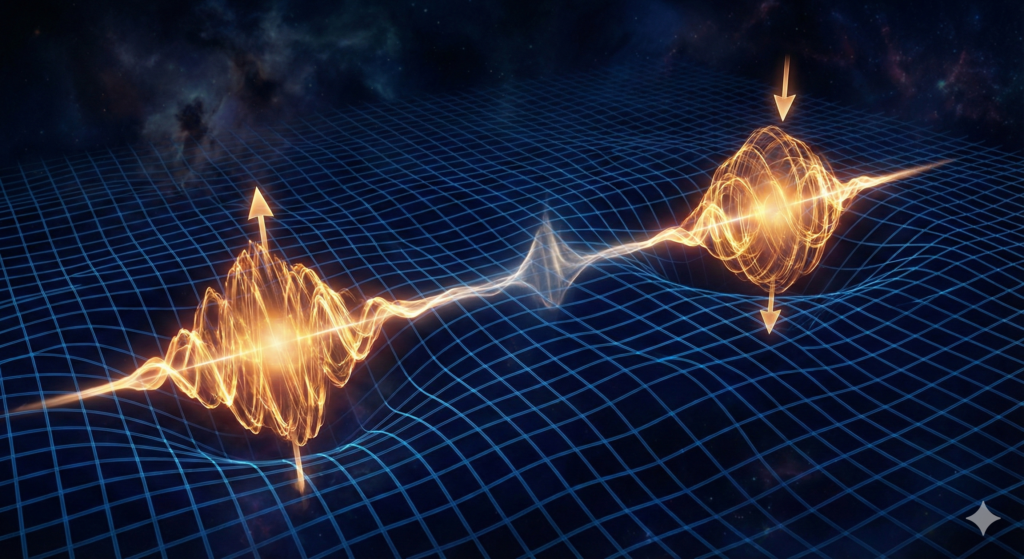
Electromagnetism is often introduced as the interaction of charges through fields that exert forces at a distance. The equations work extraordinarily well. What remains unclear is what those forces are physically doing.
This post reframes electromagnetism in mechanical terms:
Electric and magnetic effects can be understood as stress and momentum flow within a continuous medium, rather than as forces acting across empty space.
This is not a new set of equations. It is a different way of reading the ones we already trust.
From Forces to Stress
In mechanics, forces are rarely fundamental. What we call a “force” is usually the result of uneven stress within a material.
- Pressure differences push fluids.
- Tension pulls solids together.
- Shear stress redirects motion.
Electromagnetism already contains this idea—quietly.
The Maxwell stress tensor describes how electromagnetic fields carry momentum and exert pressure on matter. It is not an add-on. It is part of the theory.
Seen mechanically, the field does not “pull” on a charge.
The medium redistributes stress, and the charge follows.
Electric Fields as Stress Gradients
An electric field is typically defined as a force per unit charge. Mechanically, it can be viewed as a gradient in stored elastic energy.
- Regions of higher electric potential correspond to higher stress.
- Charges move because the surrounding medium relaxes unevenly.
- Energy is transferred through the medium, not instantaneously across space.
This is why electric forces:
- act locally,
- conserve momentum,
- and respect causality.
Nothing reaches out. Everything responds.
Magnetism as Circulation
Magnetic fields are often more mysterious. They do no work on charges, yet they bend trajectories and store energy.
In a stress–flow interpretation:
- magnetism corresponds to circulating momentum flow in the medium,
- analogous to vortical motion in fluids,
- producing sideways deflection without changing speed.
This explains why magnetic forces resemble the Magnus effect: lift without thrust, curvature without acceleration along the direction of motion.
Charges do not feel a mysterious sideways force.
They are guided by circulating stress.
The Lorentz Force Revisited
The Lorentz force law summarizes how electric and magnetic fields influence moving charges. It is compact and predictive—but it hides the mechanism.
Mechanically:
- the electric term reflects a stress gradient,
- the magnetic term reflects momentum circulation,
- together they describe how a defect moves within a stressed, flowing medium.
Nothing in this picture violates Maxwell’s equations.
It simply gives them physical content.
Momentum Lives in the Field
One of the strongest pieces of evidence for this view is that electromagnetic fields carry momentum.
- Light exerts radiation pressure.
- Fields transfer impulse without mass transport.
- Momentum conservation holds even in “empty” regions.
Momentum must reside somewhere.
The stress–flow view answers plainly: it resides in the medium itself.
Historical Perspective
James Clerk Maxwell explicitly used mechanical analogies to develop his equations, describing stresses and rotations in an underlying continuum. Later formulations retained the equations while discarding the interpretation.
What was lost was not rigor, but intuition.
This post restores that intuition without changing the mathematics.
What This Does—and Does Not—Claim
This post does not claim:
- that new electromagnetic forces exist,
- that Maxwell’s equations are incomplete,
- or that fields are literal fluids.
It does claim:
- that forces are secondary to stress,
- that fields represent stored momentum and energy,
- and that electromagnetism fits naturally within a mechanical medium.
The equations already say this. We are simply reading them literally.
Why This Matters
Understanding electromagnetism as stress–flow:
- unifies it with gravity and inertia,
- clarifies why fields carry momentum,
- removes the need for action at a distance,
- and prepares the ground for discussing modes and constraints.
With this foundation in place, we can now revisit ideas often associated with Nikola Tesla—carefully, mechanically, and without mythology.
Next:
→ Tesla’s π⁄2·c Insight Revisited