
Why Entanglement Is Not Information
SERIES IV — ELECTROMAGNETISM, MODES & CONSTRAINTS
Fields as Stress–Flow
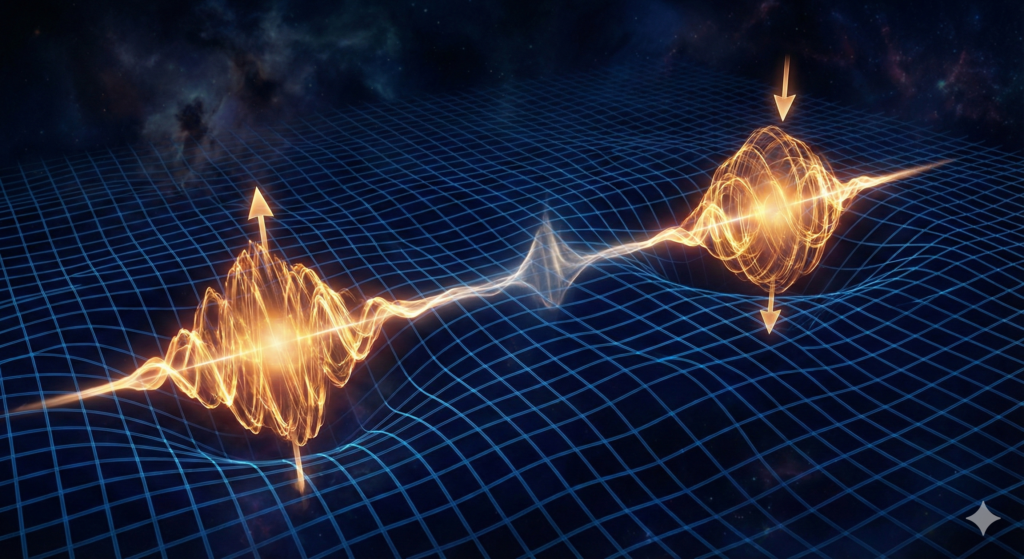
Quantum entanglement is often described as particles “communicating instantly” across space. This language is vivid—and misleading. It invites paradox, suggests superluminal signaling, and obscures what experiments actually show.
This post makes a precise distinction:
Entanglement enforces correlations. It does not transmit information.
Once that distinction is made, the mystery largely dissolves.
What Entanglement Demonstrates—and What It Does Not
Experiments inspired by John Bell show that measurements on separated systems can be strongly correlated—more strongly than any local hidden-variable model would allow.
What they do not show is:
- controllable signaling,
- energy transfer,
- or message passing between systems.
No experiment has ever allowed one observer to use entanglement to send information faster than light. This is not a technical limitation; it is a structural one.
Information Requires Control
To send information, a system must allow:
- modulation (choosing among alternatives),
- encoding (mapping choices to outcomes),
- decoding (recovering the choice elsewhere).
Entanglement provides none of these.
Measurement outcomes are random locally. Correlations appear only when results are later compared through ordinary, subluminal communication. Without that comparison, there is no message—only statistics.
Calling this “information transfer” confuses correlation with communication.
A Mechanical Analogy: Constraints, Not Signals
In mechanics, constraint enforcement is common.
- Push on one end of an incompressible rod and the other end responds.
- Tension adjusts throughout a stretched membrane.
- Boundary conditions restrict motion everywhere at once.
In none of these cases is information sent independently through the system. The response arises because the system is globally constrained.
Entanglement behaves the same way.
The systems share a common constraint imposed at preparation, not a channel opened at measurement.
The Role of Preparation
Entangled systems are not created at measurement. They are prepared in a joint state that already encodes the allowed outcomes.
Measurement does not send a signal.
It selects from the allowed set.
Seen this way:
- correlation is enforced by structure,
- randomness reflects local uncertainty,
- and comparison reveals consistency.
Nothing travels between detectors at the moment of measurement.
Why “Nonlocal” Is a Misleading Word
Entanglement is often called “nonlocal” because correlations do not decay with distance. But distance is irrelevant to constraints that are not mediated by propagation.
A standing wave does not “send” information from one node to another. The pattern exists everywhere at once because it is defined by global conditions.
Entanglement is closer to a standing constraint than a traveling signal.
A Medium Perspective
If the vacuum is a continuous medium capable of enforcing constraints:
- correlated outcomes need not imply communication,
- shared structure replaces hidden variables,
- and causality remains intact.
The medium does not transmit messages.
It restricts possibilities.
This perspective aligns naturally with the no-signaling theorem and preserves every experimental result.
Historical Perspective
Albert Einstein famously objected to “spooky action at a distance.” His discomfort was not with correlation, but with the absence of mechanism.
The constraint interpretation supplies that mechanism without altering quantum predictions.
Einstein’s instinct—that something was being misunderstood—was sound.
What This Does—and Does Not—Claim
This post does not claim:
- that quantum mechanics is incomplete,
- that entanglement is classical,
- or that hidden variables have been restored.
It does claim:
- that information requires control,
- that entanglement provides correlation, not communication,
- and that constraints explain what signals cannot.
Quantum mechanics remains intact.
Its interpretation becomes clearer.
Why This Matters
Separating correlation from information:
- removes the temptation toward superluminal explanations,
- aligns quantum behavior with mechanical intuition,
- and prepares us to discuss measurement without metaphysics.
In the next post, we examine measurement itself—not as wavefunction collapse, but as a physical transition in a constrained system.
Next:
→ Measurement as a Mechanical Transition