The Anomaly Pattern
SERIES V — ANOMALIES & REINTERPRETATIONS
When Description Is Mistaken for Reality
Modern physics is extraordinarily successful—and persistently puzzled.
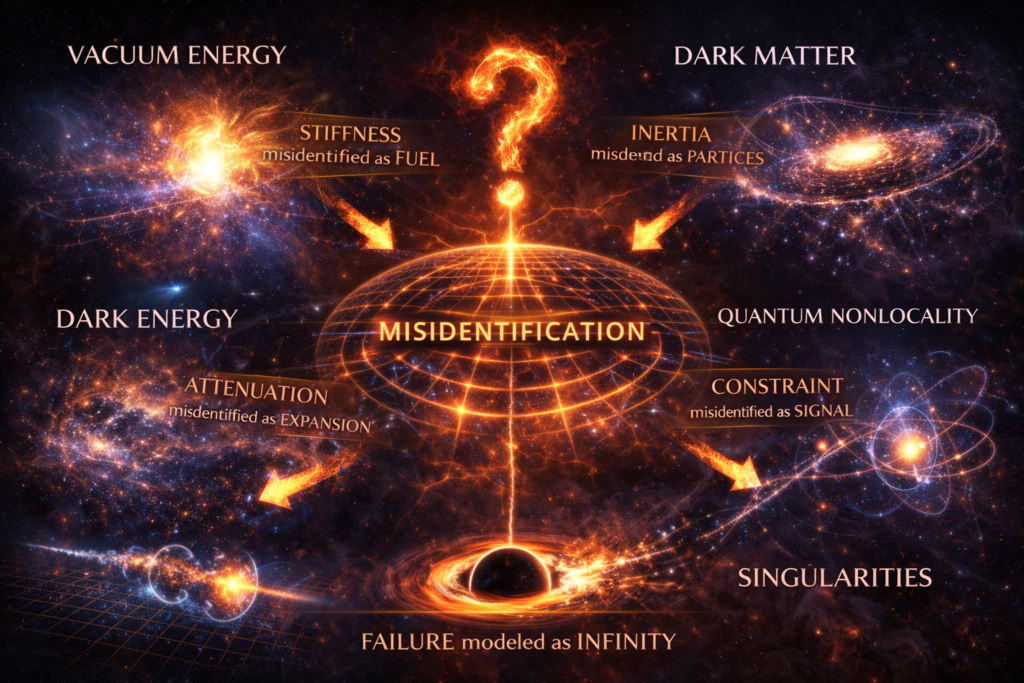
Across cosmology, quantum theory, and gravity, we encounter a familiar refrain: anomalies. Dark matter, dark energy, vacuum energy catastrophes, nonlocal correlations, and singularities are treated as unrelated problems, each demanding new entities, new principles, or new mathematics.
This post makes a quieter, unifying claim:
Most anomalies arise when descriptive tools are mistaken for physical substances.
Once that mistake is identified, the pattern becomes visible.
What an Anomaly Really Is
An anomaly is not simply a disagreement between theory and data. It is a situation where:
- predictions work locally but fail globally,
- equations remain consistent but interpretation breaks down,
- or new “things” are introduced to rescue a model.
Anomalies often signal not missing physics, but misassigned ontology—confusion about what is physically real versus what is mathematically convenient.
Description vs. Mechanism
Physics relies on abstraction. Geometry, fields, probabilities, and operators are indispensable tools. Problems arise when those tools quietly become objects.
Examples include:
- treating spacetime curvature as a force,
- treating field energy as freely gravitating mass,
- treating probability amplitudes as physical waves,
- treating vacuum energy as literal fuel.
Each move simplifies equations—and complicates reality.
A Repeating Diagnostic Pattern
Across domains, anomalies tend to share three features:
- A descriptive quantity is promoted to a physical agent
- The promoted agent produces paradoxical behavior
- New entities are introduced to compensate
Dark matter compensates for missing inertia.
Dark energy compensates for misread redshift.
Vacuum energy compensates for misinterpreted elastic preload.
The pattern repeats because the mistake repeats.
What Changes When Ontology Is Corrected
When we ask what is actually being strained, stored, or constrained, many anomalies soften or vanish.
- Geometry becomes a record of deformation.
- Fields become stress and momentum flow.
- Energy density becomes stored stiffness.
- Correlations become enforced constraints.
Nothing exotic is added. Something abstract is demoted.
Why This Keeps Happening
Historically, physics has advanced by replacing mechanisms with formalisms once predictions were secured. This is efficient—but it leaves interpretation behind.
As long as predictions work, the absence of mechanism is tolerated. Anomalies emerge only when interpretations are pushed beyond their domain of validity.
At that point, abstraction turns brittle.
Credit Where It Is Due
Physicists such as David Bohm, John Archibald Wheeler, and Robert Laughlin have all warned—explicitly or implicitly—against mistaking mathematical description for physical ontology.
This blog builds on that caution.
What This Post Is—and Is Not—Doing
This post does not claim:
- that anomalies are illusions,
- that data are wrong,
- or that new physics is impossible.
It does claim:
- that anomalies often diagnose interpretive errors,
- that mechanisms should be restored before adding entities,
- and that consistency across domains matters.
The Anomaly Rule
We will use a simple diagnostic throughout this series:
When a phenomenon appears anomalous, identify which descriptive construct has been treated as physically real.
Apply this rule, and many puzzles simplify.
Looking Ahead
The next posts apply this diagnostic to specific cases—not to “solve” them, but to show how reinterpreting the underlying medium changes what needs explaining.
We begin with the most famous anomaly of all.
Next:
→ Dark Matter Is the Medium You’re Standing In