Dark Matter Is the Medium You’re Standing In
SERIES V — ANOMALIES & REINTERPRETATIONS
When Description Is Mistaken for Reality
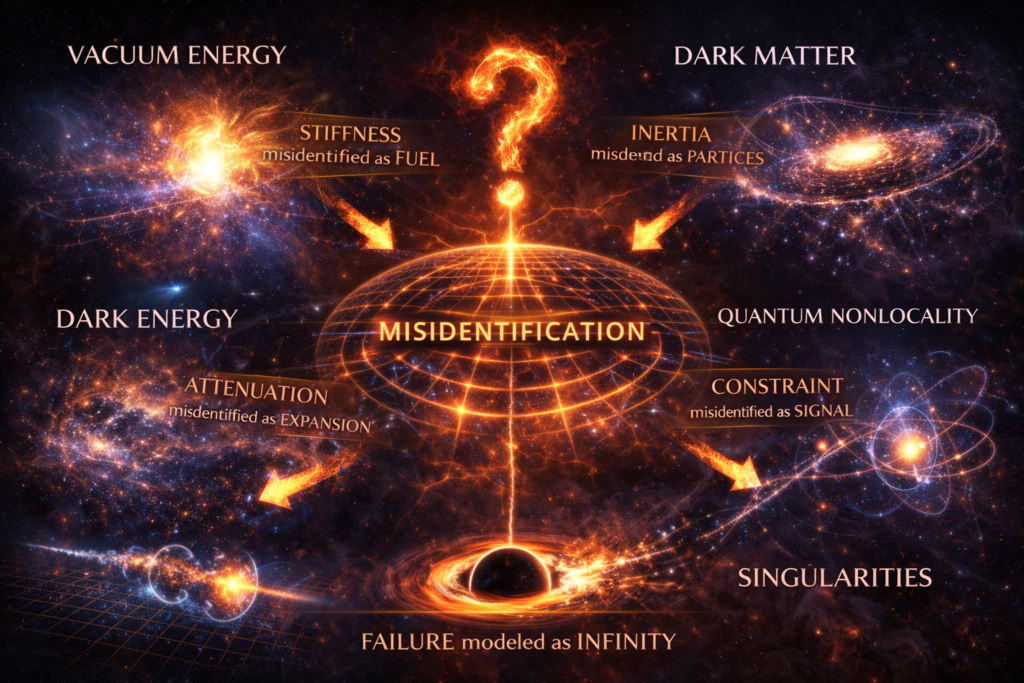
Dark matter is usually introduced as an invisible substance: a vast halo of unseen particles whose gravity explains why galaxies rotate the way they do. The idea is simple, flexible, and—so far—experimentally elusive.
This post explores a different interpretation:
What we call “dark matter” may not be missing matter at all, but the inertial and stress response of the vacuum medium itself.
This reframing preserves the observations while changing what we think is being observed.
The Observation That Started Everything
Galactic rotation curves are the core evidence for dark matter.
Stars far from a galaxy’s center orbit too quickly to be held by visible mass alone. According to Newtonian expectations, orbital speed should fall with distance. Instead, it flattens.
The standard response is to add mass.
But before adding substance, it is worth asking a more mechanical question:
What medium are these stars moving through?
Motion Through a Medium Is Never Free
In every familiar physical setting, motion through a medium involves more than the moving object itself.
- A boat carries water with it.
- A vortex entrains surrounding fluid.
- A defect drags a region of material response as it moves.
The effective inertia of the system includes both the object and the medium it organizes.
This is known in mechanics as added mass.
If galaxies are coherent, rotating structures embedded in a vacuum medium, then their dynamics must include the inertia of that medium—not just the visible stars.
Galaxies as Large-Scale Vortices
Spiral galaxies are not random assemblies. They exhibit:
- coherent rotation,
- organized structure,
- long-lived stability.
Mechanically, they resemble vortical systems.
In fluids, a vortex does not consist only of its core. Its identity includes the surrounding flow field. The faster and larger the vortex, the more medium it entrains.
From this perspective, a galaxy’s “halo” is not an added substance—it is the region of the vacuum whose motion is constrained by the galaxy’s rotation.
Why Rotation Curves Flatten
In a vortex-dominated system:
- velocity profiles are set by circulation and coupling,
- not by point-mass gravity alone.
As radius increases, the influence of the organized medium does not vanish. The medium participates in the motion, contributing effective inertia that stabilizes orbital speeds.
This produces flat rotation curves naturally—without invoking invisible particles.
Gravitational Lensing Revisited
Dark matter is also inferred from gravitational lensing. Light bends more than visible matter alone would predict.
In a mechanical interpretation:
- light propagates through a stressed medium,
- stiffness gradients guide its path,
- and the same extended medium that contributes inertia also refracts light.
Lensing traces the stress distribution, not hidden mass.
This explains why lensing maps often resemble smooth halos rather than clumpy particle distributions.
Relation to Existing Alternatives
This perspective shares surface similarities with modified-gravity ideas such as MOND, but it differs in a crucial way.
It does not modify force laws.
It modifies what is counted as participating inertia.
Interestingly, researchers like Erik Verlinde have also suggested that gravity and inertia may emerge from deeper structure. Where this framework differs is in treating the vacuum explicitly as a mechanical medium with constitutive properties.
Why “Dark” Is a Clue
Dark matter is called “dark” because it does not interact electromagnetically. That is exactly what one would expect of the vacuum itself.
The medium that carries light and enforces constraints does not radiate light. It shapes how light moves.
Dark matter is not dark because it is hidden.
It is dark because it is the background.
What This Does—and Does Not—Claim
This post does not claim:
- that dark matter particles are impossible,
- that existing observations are wrong,
- or that galaxy dynamics are trivial.
It does claim:
- that inertia can reside in a medium,
- that extended stress fields matter,
- and that adding unseen substance may be unnecessary.
This is a reinterpretation, not a denial.
Why This Matters
If dark matter reflects the medium’s participation:
- galaxy dynamics become a study of stress and flow,
- halos become regions of constrained motion,
- and cosmological modeling shifts from inventory to mechanics.
The anomaly does not disappear.
It becomes a measurement.
In the next post, we apply the same diagnostic to cosmic expansion—and ask whether another famous “dark” component is telling a similar story.
Next:
→ Dark Energy and the Cost of Propagation