Vacuum Energy Without Catastrophe
SERIES V — ANOMALIES & REINTERPRETATIONS
When Description Is Mistaken for Reality
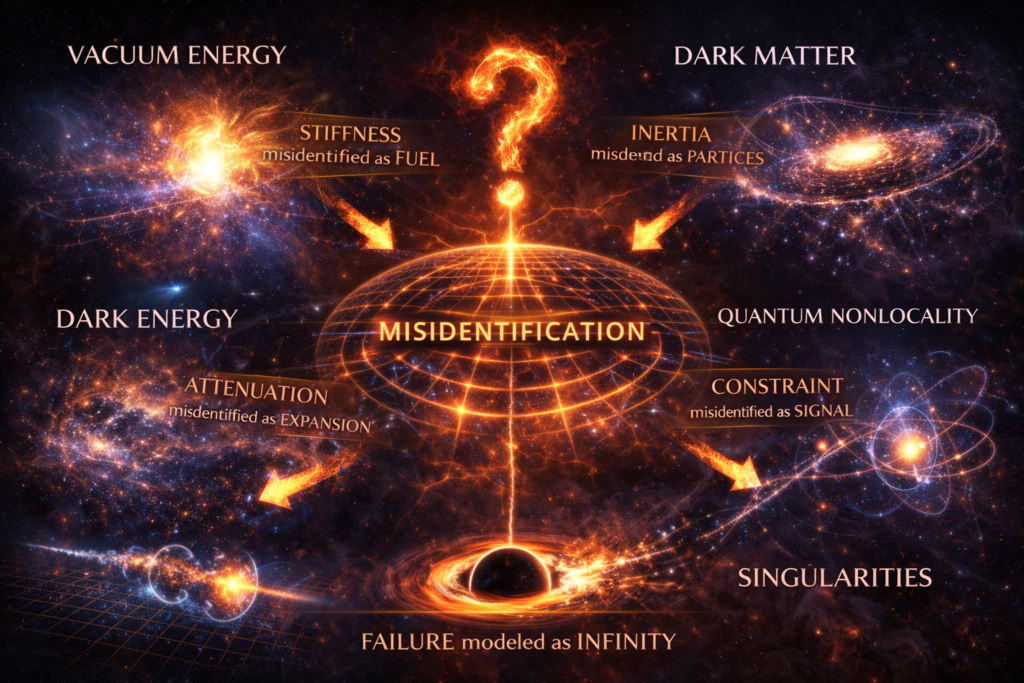
One of the most cited crises in modern physics is the vacuum energy catastrophe. Quantum field theory predicts an enormous energy density associated with empty space—so large that, if it gravitated in the usual way, the universe should curl up instantly.
It does not.
This post argues that the “catastrophe” arises from a category error:
Vacuum energy is being treated as freely gravitating mass, when it behaves more like elastic preload in a material.
Once that distinction is made, the paradox dissolves.
What the Calculation Actually Produces
In quantum field theory, every mode of a field contributes a zero-point energy. Summed naively across all modes, the resulting vacuum energy density is absurdly large.
What matters here is not the arithmetic—it is the interpretation.
The calculation tells us:
- how much energy is stored in the ground state,
- relative to an arbitrary reference,
- within a formalism designed to track fluctuations.
It does not tell us how that energy couples mechanically to gravity.
That assumption is added later.
Energy Density Is Not Automatically Gravitating
In mechanics, absolute energy density does not cause motion.
Only gradients do.
- A uniformly stretched spring stores energy but does not move.
- A preloaded structure can contain enormous stress without exerting net force.
- Stored elastic energy contributes to stability, not acceleration.
Treating vacuum energy as a source of gravity is equivalent to treating uniform preload as a driving force. It is mechanically incorrect.
The Role of Stress vs. Energy
Gravity responds to stress configuration, not bookkeeping totals.
Within the mechanical vacuum framework:
- vacuum energy corresponds to stored elastic energy,
- elastic energy corresponds to stiffness and preload,
- preload sets the medium’s response but does not generate motion.
Only variations in that response—gradients in stiffness or stress—produce gravitational effects.
Uniform vacuum energy is dynamically inert.
Why Geometry Makes This Confusing
When gravity is described geometrically, energy density appears directly in the equations. This encourages the interpretation that any energy density must gravitate.
But geometry is a description, not a mechanism.
In a material system:
- geometry reflects deformation,
- deformation reflects stress,
- and stress reflects gradients.
The vacuum energy problem arises because a descriptive quantity (energy density) is mistaken for a physical driver (stress imbalance).
Why the Universe Is Not Curled Up
If vacuum energy behaved like ordinary mass density:
- spacetime curvature would be enormous,
- cosmology would be wildly unstable,
- and observations would be impossible.
The fact that none of this occurs is not mysterious. It is diagnostic.
It tells us that vacuum energy does not couple to gravity the way mass does—because it is not the same kind of physical quantity.
A Familiar Engineering Analogy
Engineers routinely design structures with enormous internal stresses:
- prestressed concrete,
- tensioned membranes,
- compressed frameworks.
These systems are stable precisely because stresses balance internally. The stored energy does not cause collapse; it enables load-bearing behavior.
The vacuum behaves analogously.
Its large energy density reflects how stiff it is—not how much it weighs.
What This Does—and Does Not—Claim
This post does not claim:
- that zero-point energy is fictitious,
- that quantum field theory is wrong,
- or that gravity ignores energy entirely.
It does claim:
- that uniform energy density is not a force source,
- that gravity responds to constitutive structure,
- and that the vacuum energy problem is interpretive, not physical.
The calculation is correct.
The inference is not.
Why This Matters
Removing the vacuum energy catastrophe:
- eliminates the largest discrepancy in physics,
- aligns gravity with mechanical intuition,
- and reinforces the idea that anomalies diagnose ontology errors.
With this final reinterpretation in place, the anomaly pattern becomes clear.
In the next post, we step back and show how these puzzles—taken together—transform from crises into measurement tools.
Next:
→ When Anomalies Become Diagnostics