
When Anomalies Become Diagnostics
SERIES V — ANOMALIES & REINTERPRETATIONS
When Description Is Mistaken for Reality
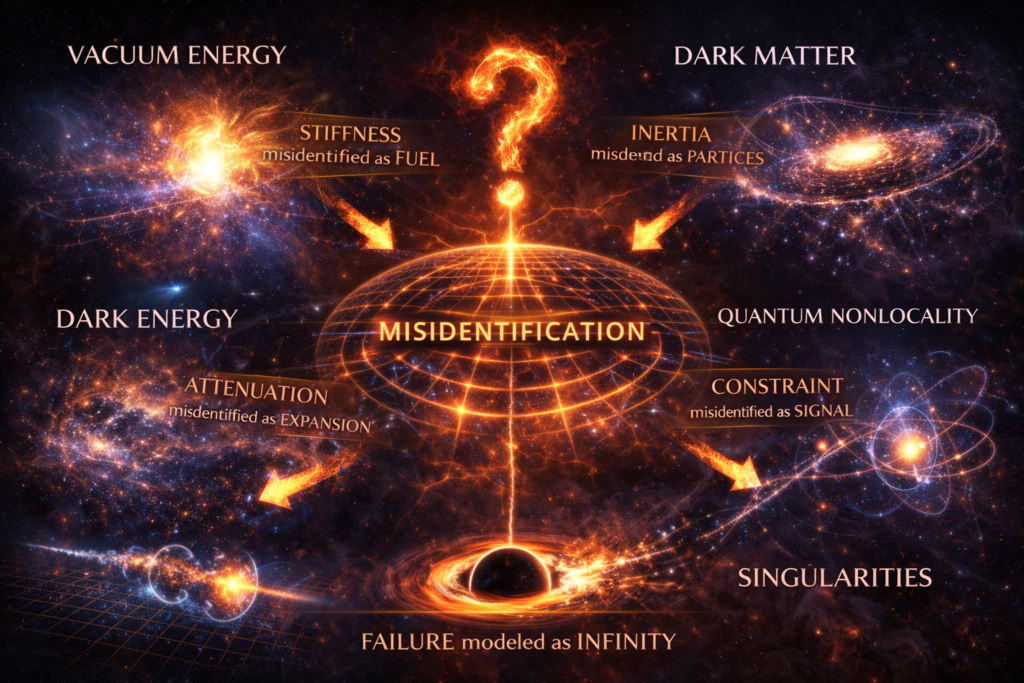
Across this series, we have examined dark matter, dark energy, black holes, and vacuum energy. Each appears, at first glance, to demand new substances, new forces, or new principles. Taken together, however, a different picture emerges.
This post makes the unifying claim explicit:
Anomalies are not failures of nature. They are measurements of where our interpretations stop matching physical mechanism.
Seen this way, anomalies are not embarrassments. They are instruments.
What Anomalies Have in Common
Despite their diversity, modern anomalies share a striking pattern:
- The equations work.
- The data are consistent.
- The interpretation produces paradox.
This is a crucial diagnostic signature.
When mathematics remains predictive but conceptual explanations proliferate uncontrollably, the problem is rarely missing physics. It is usually misplaced ontology—treating a descriptive quantity as a physical agent.
The Diagnostic Rule Revisited
We can now state the anomaly rule precisely:
When a phenomenon appears anomalous, identify which mathematical descriptor has been promoted to a physical cause.
Applied consistently, this rule explains:
- why geometry became gravity,
- why energy density became mass,
- why correlation became communication,
- and why constraints became signals.
Each promotion works locally—and fails globally.
Anomalies as Probes of the Medium
In engineering, material failures are not mysteries. They reveal:
- where assumptions break down,
- which parameters dominate response,
- and which constitutive limits have been reached.
Anomalies in physics serve the same role.
- Flat rotation curves probe inertial participation of the medium.
- Redshift anomalies probe propagation through that medium.
- Event horizons probe loss of shear support.
- Vacuum energy discrepancies probe preload vs. force.
Each anomaly measures a property of the vacuum, even when misinterpreted as something else.
Why Adding Entities Rarely Helps
Adding dark components is tempting because it preserves formalism. But it also postpones understanding.
New entities:
- absorb discrepancies,
- multiply free parameters,
- and decouple explanation from mechanism.
They solve accounting problems while leaving physical intuition untouched.
Diagnostics do the opposite: they force us to ask what is actually responding.
From Crisis to Calibration
Once anomalies are treated diagnostically:
- dark matter becomes a measure of effective inertia,
- dark energy becomes a measure of propagation cost,
- black holes become measures of constitutive limits,
- vacuum energy becomes a measure of stiffness.
The anomalies do not disappear.
They become calibration data for the medium.
What This Series Has—and Has Not—Done
This series has not claimed:
- to overthrow existing theories,
- to replace equations with stories,
- or to eliminate open questions.
It has claimed:
- that interpretation matters,
- that mechanisms should precede metaphysics,
- and that many “mysteries” arise from category errors.
The predictive frameworks remain intact.
The ontology shifts.
Why This Matters Going Forward
If anomalies are diagnostics:
- progress comes from refining constitutive models,
- not from inventing new substances,
- and not from abandoning successful mathematics.
This reframing opens a different research program—one focused on measuring the properties of the vacuum, rather than populating it with unseen objects.
Closing Series V
Series V completes a transition.
What began as a collection of unrelated puzzles now reads as a coherent set of measurements—each pointing back to the same conclusion:
The vacuum behaves like a medium, and we have been measuring it all along.
In the next series, we turn from interpretation to exploration. If the vacuum has properties, the only remaining question is how—if at all—they might be tested.
Next:
→ What Would It Mean to Engineer the Vacuum?