
What Would It Mean to Engineer the Vacuum?
SERIES VI — ENGINEERING THE VACUUM
Exploration, Not Assertion
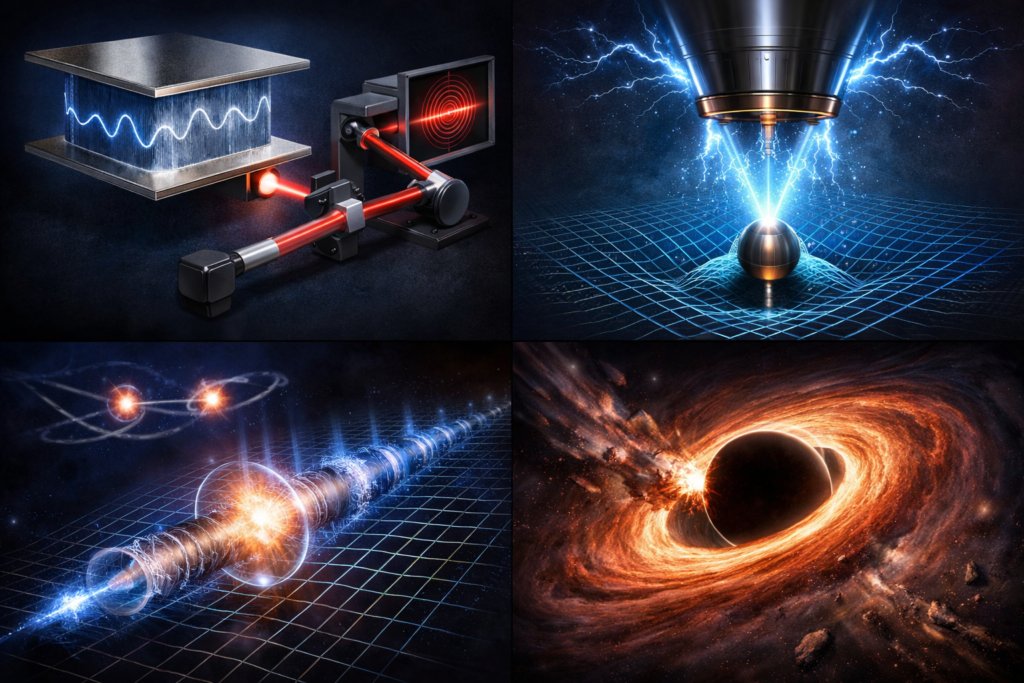
By this point in the series, the vacuum has been treated consistently as a medium—one that supports waves, stores elastic energy, enforces constraints, and responds to stress. If that picture is even approximately correct, a natural question follows:
Can the vacuum’s properties be perturbed, measured, or engineered in any controlled way?
This post defines what that question means—and, just as importantly, what it does not mean.
“Engineering” Is a Careful Word
In physics, to engineer something does not mean to control it arbitrarily. It means to:
- identify relevant parameters,
- understand how they respond to boundary conditions,
- and test whether those responses are measurable.
Engineering the vacuum does not imply:
- extracting free energy,
- violating conservation laws,
- creating reactionless thrust,
- or bypassing relativity.
Those claims require extraordinary evidence and are explicitly not assumed here.
What is being asked is far narrower—and far more conservative.
The Minimal Engineering Question
In any material system, the first engineering question is not control, but sensitivity:
Do changes in boundary conditions produce measurable changes in response?
For the vacuum, this translates to:
- Do strong fields modify local stiffness or stress?
- Do boundaries alter propagation characteristics?
- Do configurations exist where constitutive parameters shift detectably?
If the answer is no, the framework fails.
If the answer is yes, engineering becomes possible in principle.
Constitutive Parameters, Not Exotic Effects
Throughout this blog, the vacuum has been described using familiar mechanical quantities:
- stiffness,
- density,
- stress,
- and flow.
Engineering the vacuum means probing those parameters, not inventing new ones.
Examples include:
- modifying electromagnetic boundary conditions,
- creating strong stress gradients,
- shaping field geometries that concentrate response,
- and measuring small changes in wave propagation or force balance.
These are standard experimental strategies—applied to an unfamiliar medium.
Stress vs. Energy (Again)
A recurring theme bears repeating.
In materials:
- energy storage alone produces no motion,
- gradients of stress produce forces.
Any credible attempt to interact with the vacuum must therefore focus on structured stress, not large energy budgets.
High fields applied uniformly are uninteresting.
Modulated, asymmetric, or constrained fields are where mechanics lives.
Why Subtle Effects Matter
If the vacuum is extraordinarily stiff—as earlier posts have suggested—then any perturbation will be small.
That does not make it irrelevant.
In materials science:
- elastic moduli are measured through tiny strains,
- refractive indices through minute delays,
- and structural transitions through threshold behavior.
The question is not whether effects are large, but whether they are systematic, repeatable, and bounded by theory.
The Role of Null Results
Engineering begins with falsification.
A well-designed experiment that produces a null result:
- constrains constitutive models,
- rules out entire classes of speculation,
- and sharpens what questions remain meaningful.
This series treats null results as successes, not failures.
If the vacuum cannot be perturbed measurably under any achievable condition, that conclusion is valuable.
Historical Perspective
Precision experiments have often revealed medium-like behavior where none was expected:
- elastic properties of solids inferred from wave speeds,
- electromagnetic constants inferred from circuit behavior,
- material nonlinearities discovered at extreme fields.
Vacuum engineering, if it exists at all, will follow this tradition—not dramatic demonstrations, but careful measurements.
What This Does—and Does Not—Claim
This post does not claim:
- that vacuum engineering is currently feasible,
- that anomalous propulsion exists,
- or that laboratory-scale control is guaranteed.
It does claim:
- that the question is well-posed,
- that it can be framed mechanically,
- and that it admits experimental answers.
Engineering begins with definition, not ambition.
Why This Series Exists
Series VI exists to prevent a familiar failure mode: jumping from interpretation directly to speculation.
By insisting on:
- constitutive parameters,
- mechanical language,
- and explicit falsifiability,
this series keeps the discussion grounded—even when the questions are unconventional.
In the next post, we narrow the focus further and examine where, in any physical system, work is actually done.
Next:
→ Stress, Not Energy: Where the Work Actually Goes