Casimir Cavities as Constitutive Probes
SERIES VI — ENGINEERING THE VACUUM
The Effective Medium View
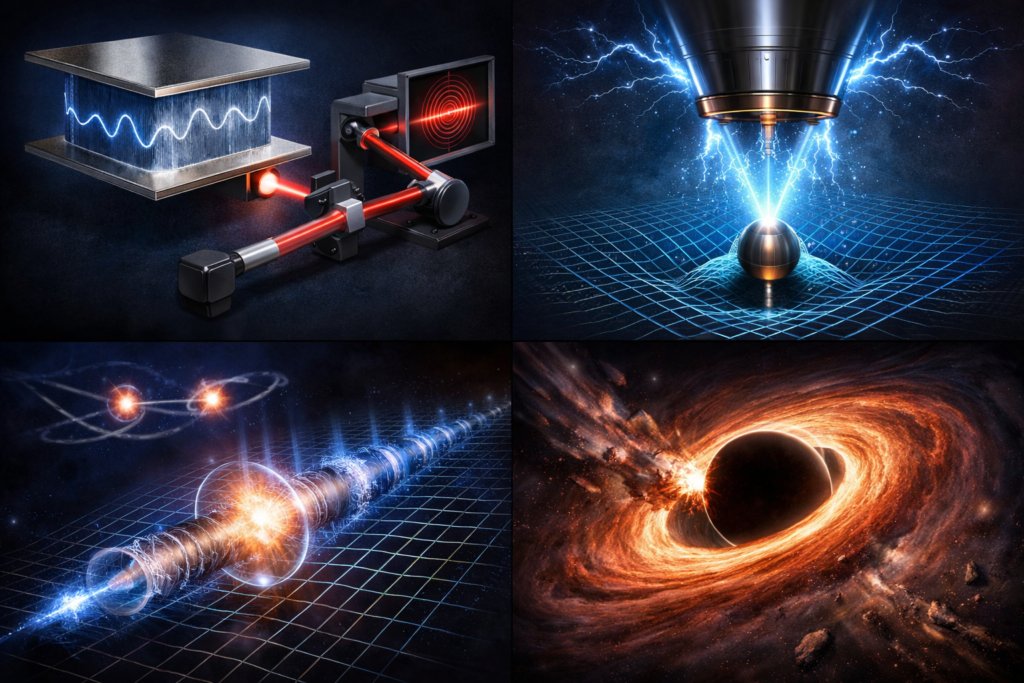
Among all phenomena discussed in connection with the vacuum, one stands apart for its experimental cleanliness: the Casimir effect. It produces a measurable force, requires no exotic materials, and has been reproduced across laboratories for decades.
For this reason alone, it deserves careful attention.
This post reframes the Casimir effect not as evidence of “vacuum energy extraction,” but as something more conservative and more useful:
Casimir cavities function as probes of the vacuum’s constitutive response to boundary conditions.
They tell us how the medium reacts—not how to exploit it.
What the Casimir Effect Actually Is
When two conducting plates are placed very close together in vacuum, an attractive force appears between them. This effect was first predicted by Hendrik Casimir and has since been confirmed experimentally with high precision.
The standard explanation invokes changes in allowed electromagnetic modes between the plates:
- fewer modes fit inside the cavity,
- more modes exist outside,
- the imbalance produces pressure.
Mathematically, this works. Mechanically, it leaves open an important question:
What is responding to the boundary conditions?
Boundaries Matter in Real Materials
In every physical medium:
- boundaries restrict motion,
- mode structure changes,
- and stresses rearrange.
A violin string vibrates differently when clamped.
A membrane’s tension changes with geometry.
A cavity alters acoustic pressure.
The Casimir effect fits squarely into this category.
The plates do not “pull” each other through empty space.
They modify how the surrounding medium can respond.
Stress, Not Extraction
A crucial clarification must be made.
The Casimir effect does not demonstrate:
- usable energy extraction,
- net work over a cycle,
- or violation of conservation laws.
It demonstrates stored stress arising from constrained modes.
Like compressing a spring:
- work must be done to move the plates,
- energy is stored in the configuration,
- and removing the constraint returns that energy.
Nothing free is obtained.
Why Casimir Is So Important
The Casimir effect matters because:
- it is purely boundary-driven,
- it operates in high vacuum,
- it involves no charges flowing,
- and it produces a mechanical force.
This makes it one of the few phenomena where the vacuum’s response can be directly measured without ambiguity.
If the vacuum were truly inert, no such force would appear.
Constitutive Information Hidden in Casimir Data
From an effective-medium perspective, Casimir experiments encode information about:
- how stiffness depends on allowed modes,
- how stress redistributes under confinement,
- how boundary geometry alters response.
Different plate materials, geometries, and separations probe different aspects of this response.
Seen this way, Casimir cavities are not curiosities—they are material test fixtures.
Why Casimir Does Not Scale Easily
Casimir forces drop rapidly with distance. This is often cited as evidence that the effect is irrelevant beyond nanoscales.
Mechanically, this is exactly what one would expect.
Confinement effects are strongest when:
- boundaries are close,
- mode restriction is severe,
- and stress gradients are sharp.
As separation increases, the medium relaxes and the effect fades.
This behavior is not a flaw—it is diagnostic.
Casimir vs. Speculative Vacuum Devices
Casimir experiments differ fundamentally from many speculative vacuum-force claims:
- they operate in controlled vacuum,
- they eliminate ionic and thermal effects,
- they obey conservation laws,
- and they scale predictably.
They are boring in the best possible way.
Any proposed vacuum-engineering effect that contradicts Casimir behavior without explanation is almost certainly flawed.
What This Does—and Does Not—Claim
This post does not claim:
- that Casimir forces can be harnessed for propulsion,
- that vacuum energy can be tapped,
- or that nanoscopic effects scale macroscopically.
It does claim:
- that the vacuum responds to boundaries,
- that this response produces stress,
- and that Casimir experiments provide a clean window into constitutive behavior.
They are measurements, not miracles.
Why This Matters Going Forward
If vacuum engineering exists at all, it will resemble Casimir physics:
- subtle,
- boundary-driven,
- stress-based,
- and tightly constrained by conservation laws.
The next step is not grand devices, but careful generalization: asking how different boundary conditions—not just parallel plates—modify the medium’s response.
That question closes this series by returning us to fundamentals.
Next:
→ Limits, Symmetry, and Why Reactionless Drives Keep Failing