
Why Mechanism Still Matters
SERIES VII — FOUNDATIONS REVISITED
Explanation Before Abstraction
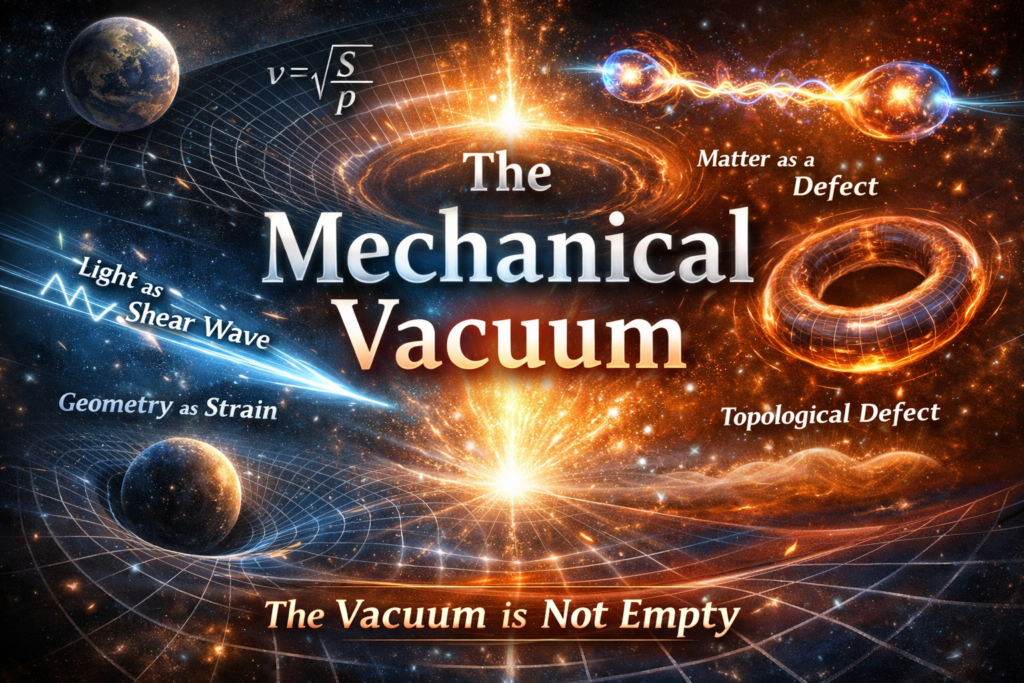
Modern physics is extraordinarily good at prediction. Its equations work across astonishing ranges of scale and precision. Yet again and again—especially when anomalies arise—we find ourselves asking a basic question that the mathematics does not answer:
What is actually happening?
This post argues that asking for mechanism is not a regression to outdated thinking. It is a prerequisite for understanding.
Prediction Is Not Explanation
A model can predict outcomes flawlessly and still leave us conceptually lost.
History is full of such examples:
- Epicycles predicted planetary motion accurately—until they didn’t.
- Thermodynamic laws worked long before atoms were accepted.
- Quantum rules predict measurements without explaining measurement.
Prediction tells us what will happen.
Mechanism tells us why it happens that way.
Confusing the two leads to intellectual stagnation.
Why Mechanism Was Set Aside
Mechanistic explanations fell out of favor for practical reasons:
- they were hard to formalize,
- early attempts relied on flawed analogies,
- and abstraction delivered faster results.
Geometry replaced substance.
Fields replaced media.
Operators replaced motion.
These moves were enormously productive—but they came with a cost: physical intuition was deferred, not eliminated.
What Gets Lost Without Mechanism
When mechanism is absent:
- descriptive quantities harden into “things,”
- bookkeeping variables become physical agents,
- and anomalies multiply.
We saw this pattern repeatedly:
- curvature mistaken for force,
- energy density mistaken for mass,
- correlation mistaken for communication,
- constraints mistaken for signals.
Each confusion arises when explanation is replaced by description.
Mechanism as a Unifier
Mechanism does something abstraction cannot do alone: it connects domains.
- Stress explains gravity, electromagnetism, and inertia with the same language.
- Waves explain light, matter, and stability with the same structure.
- Constraints explain rigidity, entanglement, and boundary effects without signaling.
Mechanism reduces the number of ideas needed—not by force, but by coherence.
The Mechanical Medium as an Example
Throughout this blog, the vacuum has been treated as a medium—not to revive discarded ether theories, but to restore explanatory continuity.
This move:
- does not change predictions,
- does not violate experiments,
- does not add entities.
It simply answers questions that geometry leaves unanswered:
- What is stressed?
- What carries momentum?
- What enforces constraints?
These are mechanistic questions—and they matter.
Why This Is Not Anti-Mathematics
Asking for mechanism is not a rejection of mathematics.
Mathematics remains the language of precision.
Mechanism provides the referent.
The most durable theories in physics—classical mechanics, elasticity, thermodynamics—combine both. Where they fail, it is often because one was allowed to replace the other.
Abstraction without mechanism drifts.
Mechanism without mathematics stagnates.
Credit Where It Is Due
Physicists across generations have warned against abandoning explanation entirely—among them Albert Einstein, who repeatedly emphasized the need for intelligibility, and Richard Feynman, who insisted that equations should connect to physical pictures.
Their caution was not philosophical. It was practical.
What This Post Does—and Does Not—Claim
This post does not claim:
- that all mechanisms are known,
- that current theories are wrong,
- or that intuition should override evidence.
It does claim:
- that explanation is part of understanding,
- that mechanisms discipline interpretation,
- and that abandoning them guarantees confusion later.
Mechanism is not optional—it is deferred cost.
Closing the Series
This final post closes a long arc.
We began by questioning geometry, fields, and abstraction—not to discard them, but to ground them. Along the way, anomalies transformed into diagnostics, limits clarified ambition, and speculation was narrowed by mechanics.
The conclusion is simple:
When physics forgets mechanism, it does not become deeper—it becomes fragile.
Restoring mechanism does not end inquiry.
It makes progress possible again.
End of Series VI