
Why Motion Doesn’t Reveal a Preferred Frame
SERIES VII — LIVING IN A SOLID VACUUM
How Motion, Freedom, and Transparency Are Possible
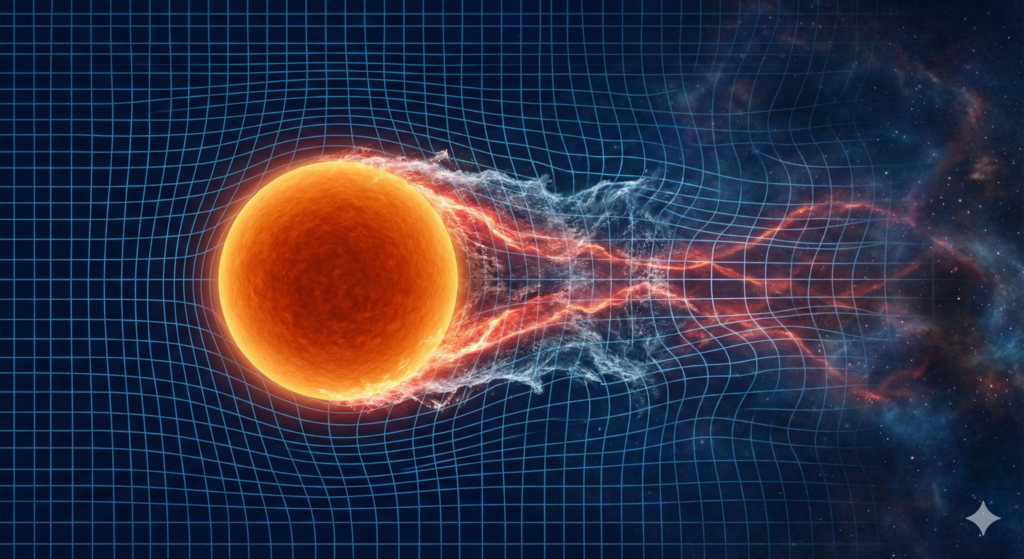
Once a physical medium is introduced, a familiar objection quickly follows:
If space is a medium, shouldn’t there be a true state of rest? Shouldn’t motion through it be detectable?
This concern is so ingrained that it is often treated as decisive.
In fact, when approached mechanically, it dissolves.
The key is understanding what a medium responds to—and what it does not.
Velocity Does Not Produce Stress
In mechanics, stress arises from deformation, not from uniform motion.
An elastic medium responds when it is:
- Stretched
- Compressed
- Sheared
- Twisted
Uniform translation does none of these.
If every part of the medium and every object embedded in it moves together at constant velocity, there is:
- No relative deformation
- No strain
- No stress
- No signal to detect
Velocity alone is mechanically meaningless.
Only Acceleration Leaves a Trace
Acceleration is different.
When motion changes, the medium must reorganize:
- Stress builds asymmetrically
- Information propagates at a finite speed
- Resistance appears
This is why acceleration is detectable while uniform motion is not.
It is also why inertia exists at all, a topic we will return to in the next post.
A medium that only responds to changes in motion does not define an observable rest frame.
Why Measuring Devices Can’t Detect Motion Either
A subtle but critical point is often missed:
All measuring devices are themselves made of the medium.
Rods, clocks, interferometers, and detectors:
- Are constructed from defects of the vacuum
- Obey the same stress–flow rules
- Contract, dilate, and synchronize according to the same constitutive behavior
If the medium changes, both the signal and the measuring apparatus change together.
There is nothing left to compare against.
Lorentz Invariance as a Material Symmetry
In conventional physics, Lorentz invariance is often treated as a deep geometric principle imposed on spacetime.
In a mechanical vacuum, it emerges naturally.
Whenever:
- Signals propagate at a finite speed
- Stress responds only to deformation
- Measuring systems are embedded in the same medium
…the resulting wave equations are Lorentz invariant.
This is not mysterious. The same symmetry appears in elastic wave systems, acoustic analogs, and condensed-matter models where no preferred frame is observable despite an underlying substrate.
Relativity is not evidence against a medium.
It is evidence for a very specific kind of one.
Why the Historical “Aether Wind” Was Never Found
Early experiments searched for motion through space by assuming the medium would behave like air or water—producing drag or phase shifts proportional to velocity.
But a medium that:
- Is extremely stiff
- Has vanishing dissipation
- Responds only to strain
will not behave that way.
The failure to detect an “aether wind” did not rule out a medium.
It ruled out the wrong kind of medium.
Rest Is Undetectable by Construction
In this framework:
- There may exist a local rest frame of the medium
- But it is mechanically irrelevant
- And experimentally inaccessible
Only gradients, accelerations, and failures of uniformity produce observable effects.
A preferred frame can exist without being detectable—because nothing in the physics couples to it.
Key Takeaway
A physical medium does not imply a detectable state of rest.
If stress depends on deformation rather than velocity, then uniform motion leaves no imprint—no matter how real the medium may be.
This is not a loophole.
It is a direct consequence of mechanics.
In the next post, we’ll turn to the one circumstance where the medium does push back—and show how this explains inertia without invoking any new principles at all.