
What Would Count as Evidence for a Structured Vacuum?
SERIES VIII — WHAT COULD THE MEDIUM BE MADE OF?
Candidate Substrates & Harmonic Structure
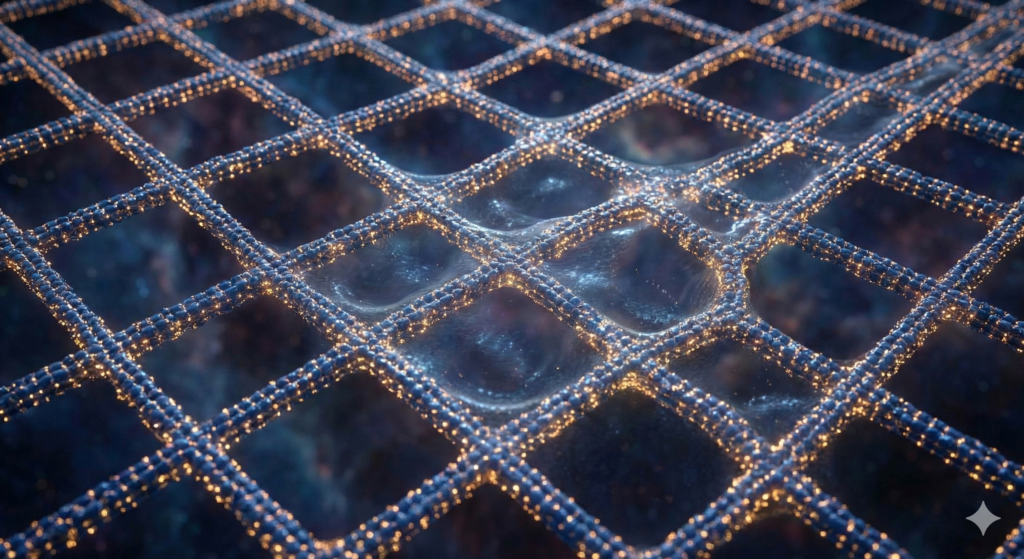
Speculation is only useful if it knows how to stop.
After exploring the possibility that the vacuum might possess structure below the threshold of chemistry, the most important question is not whether it is appealing, but whether it is testable in principle.
What would count as evidence that the vacuum has internal structure—and what would rule the idea out entirely?
This post is about drawing that line clearly.
What Would Not Count as Evidence
First, it’s important to be explicit about what does not qualify.
- Mathematical elegance
- Historical intuition
- Conceptual unification
- Analogies to music, harmony, or aesthetics
None of these are evidence.
A mechanical hypothesis survives only if it predicts consequences that differ, even subtly, from alternative descriptions.
The Right Kind of Evidence Is Indirect
If the vacuum has substructure below chemistry, that structure is—by construction:
- saturated,
- extremely stiff,
- and inaccessible to direct probing.
We should therefore not expect:
- new particles,
- new spectral lines,
- or direct scattering signatures.
Evidence, if it exists, will be indirect and constitutive, not particulate.
Constitutive Parameters as the Primary Diagnostic
In a mechanical framework, the vacuum is characterized by a small set of parameters:
- effective density,
- shear stiffness,
- bulk response,
- loss (or lack thereof).
Evidence for structure would appear as:
- unexpected regularities in these parameters,
- scale-dependent behavior,
- or correlations across domains that otherwise seem unrelated.
The question becomes: do these parameters behave as if they are emergent from something structured?
Consistency Across Regimes
One potential diagnostic is cross-regime coherence.
If the same underlying medium governs:
- light propagation,
- inertial response,
- gravitational refraction,
- and constraint enforcement,
then their characteristic scales should not be arbitrary.
Evidence would take the form of:
- repeated ratios,
- recurring thresholds,
- or harmonic relationships
appearing independently in optics, mechanics, and cosmology.
Such coherence would suggest shared structure rather than coincidence.
Anomalies as Material Signatures
Many long-standing “anomalies” in physics are not failures of prediction, but failures of interpretation.
In a constitutive view, anomalies become diagnostics:
- not signs of new forces,
- but signs of misidentified material behavior.
If multiple anomalies resolve cleanly when interpreted as:
- stiffness variation,
- saturation,
- loss,
- or failure,
that convergence itself becomes evidence for a structured medium.
No single anomaly is decisive.
Patterns are.
Negative Evidence Matters More
Equally important is what would falsify the idea.
The structured-vacuum hypothesis would be seriously undermined if:
- constitutive parameters showed no coherence across scales,
- wave speed, inertia, and gravitational response required unrelated mechanisms,
- or new observations demanded freely interacting vacuum constituents.
A framework that can never be wrong is not physics.
Why This Is Hard—and Acceptable
Some readers will object that this standard of evidence is too weak.
But physics routinely accepts indirect evidence when direct access is impossible:
- atomic structure was inferred before atoms were seen,
- lattice order was deduced from diffraction,
- fields were accepted long before they were measured locally.
What matters is not immediacy, but constraint.
Does the hypothesis narrow possibilities—or expand them arbitrarily?
A Modest Claim
The claim here is intentionally modest:
If the vacuum has structure, it will reveal itself through constrained, repeatable patterns in how it responds—not through new objects appearing in detectors.
This keeps the idea grounded and falsifiable, even if difficult.
Key Takeaway
Evidence for a structured vacuum would be constitutive, indirect, and cross-disciplinary—or it would not exist at all.
Speculation earns its place only by sharpening our expectations, not by escaping them.
With that standard in place, we can now close this series responsibly—by stating exactly where speculation must stop, and mechanics must take over alone.
That boundary is the subject of the final post.