
What Is an Atom, Mechanically?
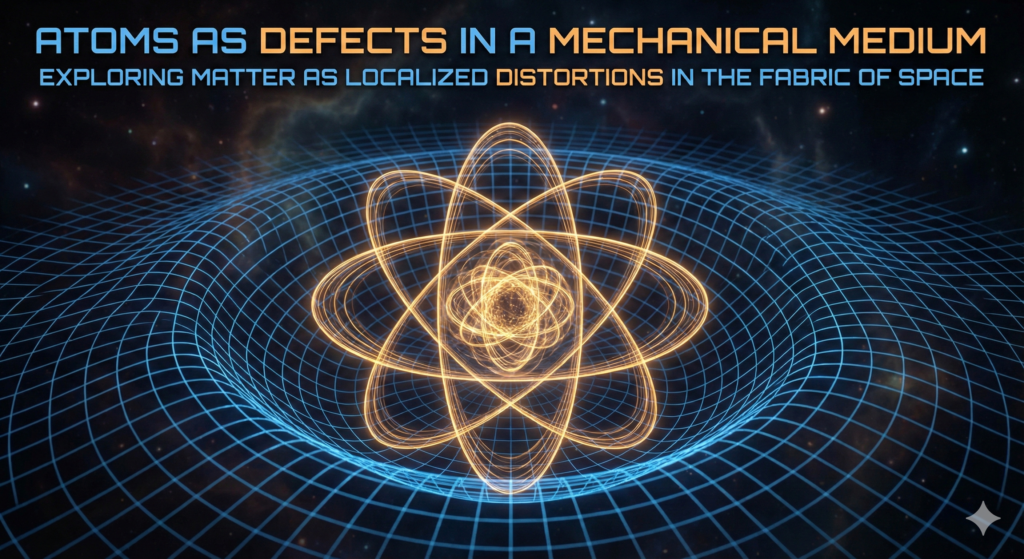
SERIES IX — ATOMS AS DEFECTS IN A MECHANICAL MEDIUM
Why the Periodic Table Looks Like a Standing Wave
Before we can recompute physics from first mechanics, we must answer a deceptively simple question:
What is an atom, mechanically?
Not mathematically.
Not historically.
Not by postulate.
Mechanically.
This question sits at the hinge of the entire framework. If we get it wrong—or leave it vague—everything that follows becomes unstable.
The Standard Answer Is Not a Mechanical Answer
In conventional physics, atoms are described using a patchwork of ideas:
- particles with no size,
- wavefunctions with no substance,
- forces acting at a distance,
- probability clouds standing in for structure.
These descriptions are predictively effective, but they do not answer a mechanical question. They tell us how atoms behave, not what they are.
A mechanical theory cannot stop there.
The Atom as a Defect, Not a Building Block
In a mechanical vacuum framework, the atom is not a fundamental constituent of reality.
It is a localized, persistent defect in a continuous medium.
This is a critical inversion:
- The vacuum is primary
- Atoms are secondary
- Matter is emergent
An atom exists for the same reason a vortex exists in a fluid or a dislocation exists in a crystal:
because the medium permits a stable topological configuration that cannot be removed without global reorganization.
Why Defects Are the Right Ontology
Defects have properties that atoms must have:
- Localization — they occupy a finite region
- Persistence — they survive motion and interaction
- Identity — they remain the “same thing” over time
- Universality — they exist wherever the medium exists
Waves alone do not satisfy these requirements.
Particles without a medium do not either.
Defects do.
What a Defect Is (and Is Not)
A defect is not:
- a lump of substance,
- a miniature object floating in space,
- or a wave packet that spreads freely.
A defect is:
- a constrained configuration of stress and flow,
- stabilized by the medium’s constitutive response,
- protected by topology rather than energy barriers alone.
You cannot remove a true defect by gently perturbing it.
You must unwind the medium itself.
Why Atoms Are Not Standing Waves
This distinction matters.
Standing waves are constraints.
They determine which configurations are allowed.
Atoms are defects.
They are the configurations that occupy those allowed states.
Saying “atoms are waves” collapses this distinction and leads to confusion.
Saying “atoms are defects governed by standing-wave admissibility” preserves mechanical clarity.
This framework takes the second path.
The Role of the Medium
An atom cannot exist without the medium that supports it.
The medium:
- supplies stiffness,
- enforces continuity,
- redistributes stress,
- and provides restoring response.
Remove the medium, and the defect cannot persist.
In this sense, atoms are not in space.
They are configurations of space itself.
Why This Definition Matters Going Forward
Every quantity we care about—mass, charge, spin, inertia—must ultimately be explained in terms of:
- how a defect deforms the medium,
- how it couples to waves,
- and how it resists reconfiguration.
If we define the atom incorrectly, every later explanation becomes ad hoc.
If we define it correctly, much of physics stops being mysterious.
Key Takeaway
An atom is a stable topological defect in a mechanical vacuum, not a fundamental particle and not a standing wave.
Standing-wave modes constrain which defects are allowed.
Defects carry identity and persistence.
With this ontology in place, we can now ask the next necessary question:
Why must atoms take the specific forms they do—and why are some configurations stable while others are forbidden?
That is where we turn next.