
Why Atoms Must Be Defects (Not Waves)
SERIES IX — ATOMS AS DEFECTS IN A MECHANICAL MEDIUM
Why the Periodic Table Looks Like a Standing Wave
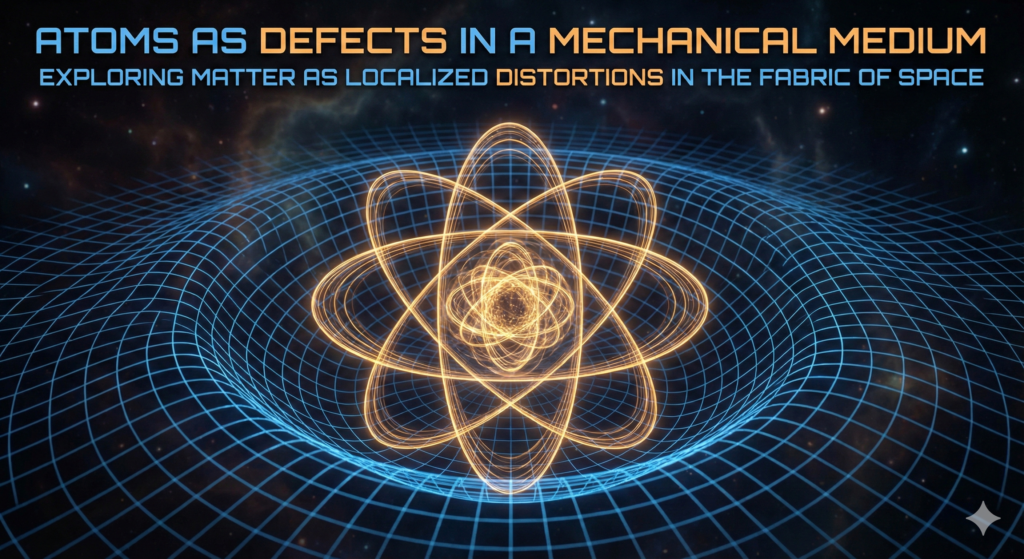
Now that we’ve defined the atom mechanically—as a stable topological defect—we need to address a tempting alternative that repeatedly resurfaces:
Why not treat atoms as standing waves or localized wave packets of the medium itself?
At first glance, this seems appealing. Standing waves are structured, quantized, and ubiquitous in physics. But mechanically, they fail to do something atoms must do:
persist as identifiable objects.
Waves Do Not Have Identity
A wave is a pattern of motion.
Patterns can be precise—but they are not things.
In a continuous medium:
- waves propagate,
- superpose,
- interfere,
- and disperse.
Even standing waves persist only because boundary conditions enforce them. Remove the boundaries, and the pattern dissolves.
Atoms do not behave this way.
- They survive collisions
- They move without spreading
- They retain identity over time
A pure wave cannot satisfy these requirements.
Wave Packets Always Spread
One might try to rescue the wave picture by invoking wave packets—localized superpositions of modes.
But mechanically, wave packets are unstable:
- different components travel at different speeds,
- phase coherence degrades,
- localization is lost.
This is not a quantum problem.
It is a property of waves in any dispersive medium.
Atoms, by contrast, do not delocalize simply because time passes.
Standing Waves Require External Enforcement
Standing waves exist only because something enforces them:
- rigid boundaries,
- cavities,
- reflecting surfaces.
But atoms do not sit inside containers provided by something else.
If an atom were a standing wave, we would have to ask:
What is providing the boundary conditions?
Answering “the atom itself” is circular.
Defects avoid this problem entirely.
Defects Are Self-Supporting
A topological defect does not need external walls.
It is stabilized because:
- the medium cannot smoothly unwind it,
- continuity enforces persistence,
- removal requires global rearrangement.
This is why:
- vortices persist in fluids,
- dislocations persist in crystals,
- knots persist in elastic media.
Atoms exhibit the same kind of robustness.
Defects Survive Interaction
When waves interact, they pass through one another and reconfigure.
When defects interact:
- they scatter,
- bind,
- combine,
- or annihilate—
but they do so as entities.
Chemical reactions would be impossible if atoms were mere waves.
There would be nothing to rearrange—only patterns to interfere.
Chemistry requires objects.
Why Waves Still Matter
Rejecting “atoms as waves” does not diminish the role of waves.
It clarifies it.
Standing-wave modes:
- define admissible configurations,
- impose quantization conditions,
- constrain stability.
They act as rules, not actors.
Atoms are the actors.
A Clean Mechanical Separation
This framework enforces a disciplined separation:
- Medium → supports stress and waves
- Modes → define admissible states
- Defects → occupy those states
Collapsing these roles leads to confusion.
Keeping them distinct produces clarity.
Why This Matters for Everything That Follows
If atoms were waves:
- mass would be ill-defined,
- localization would be fragile,
- interaction would be incoherent.
Because atoms are defects:
- mass reflects medium deformation,
- charge reflects circulation,
- stability reflects topology.
Everything downstream depends on this choice.
Key Takeaway
Atoms cannot be waves, because waves do not persist.
Atoms must be defects, because defects are what persist in a continuum.
Standing waves govern where atoms may exist.
Defects explain why they exist at all.
With that distinction locked in, we are ready to tackle the next structural question:
If atoms are defects, why do they organize into shells—and why only certain shells are allowed?
That is where we go next.