
Why Atomic Shells Exist at All
SERIES IX — ATOMS AS DEFECTS IN A MECHANICAL MEDIUM
Why the Periodic Table Looks Like a Standing Wave
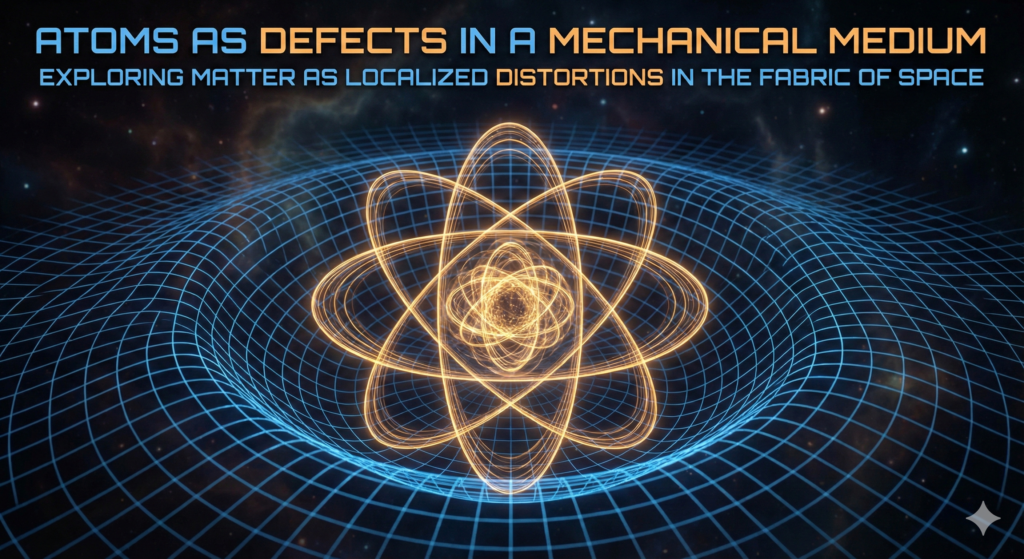
If atoms are defects in a mechanical medium—not waves themselves—then the next question is unavoidable:
Why do defects organize into shells at all?
Why isn’t an atom just a single, featureless knot of stress?
Why do we see discrete layers, sharp transitions, and repeating structure?
The answer is mechanical, not quantum.
Defects Must Be Compatible with the Medium
A defect cannot take an arbitrary shape.
Because it exists within a continuous medium, it must satisfy the medium’s constraints:
- continuity,
- stiffness,
- stress balance,
- and finite propagation speed.
Only certain configurations allow stress to circulate and redistribute without tearing, collapsing, or radiating away.
Those admissible configurations are not continuous.
They come in discrete families.
Shells Are Admissible Stress Envelopes
In this framework, an atomic shell is not an orbit and not a particle layer.
It is a stable stress envelope surrounding a core defect.
Each shell corresponds to:
- a region where stress and circulation can close on themselves,
- without producing runaway deformation,
- and without destabilizing inner structure.
Between shells lie inadmissible regions—configurations where stress cannot be supported coherently.
That is why shells are discrete.
Why Standing Waves Enter the Picture
Standing-wave language appears here—but carefully.
Standing-wave modes of the surrounding medium:
- define where stress can be stationary,
- set nodal and antinodal surfaces,
- and constrain closure lengths and curvature.
They do not create the atom.
They govern which shell configurations are allowed.
Think of them as the rules of the medium, not the substance of the defect.
Shell Radii Are Not Arbitrary
Once a defect forms, the surrounding medium must accommodate it.
Only at specific radii can:
- inward restoring stress,
- outward circulation,
- and shear stiffness
balance simultaneously.
Those radii are picked out by modal compatibility, not by energetic preference alone.
That is why shell spacing follows patterns—and why those patterns repeat across elements.
Why There Is Empty Space Between Shells
The “gaps” between shells are not empty because something is missing.
They are empty because:
- no stable stress configuration exists there,
- any attempt to localize stress collapses or leaks away,
- the medium refuses to support intermediate states.
This is a key insight:
Shells exist not because something occupies them,
but because everything else is forbidden.
Why Shells Stack Without Collapsing
As additional circulation or coupling is introduced:
- inner shells become saturated,
- stress redistributes outward,
- new admissible envelopes appear.
The defect grows in complexity, not by piling matter inward, but by opening new closure regions outward.
This explains why atoms grow by adding shells rather than densifying indefinitely.
A Mechanical Reframing of “Orbitals”
What are traditionally called orbitals can be reinterpreted as:
- families of admissible stress configurations,
- shaped by the medium’s constitutive response,
- labeled mathematically but governed mechanically.
The mathematics describes the allowed states well.
The mechanics explains why only those states exist.
Key Takeaway
Atomic shells exist because only certain stress envelopes are mechanically admissible around a stable defect.
Standing-wave modes constrain those envelopes.
Defects occupy them.
With shells understood mechanically, the next question becomes sharper:
Why do shells abruptly close—and why does chemistry reset so dramatically when they do?
That closure behavior is the key to periodicity—and it’s where we turn next.