
Why the Periodic Table Repeats
SERIES IX — ATOMS AS DEFECTS IN A MECHANICAL MEDIUM
Why the Periodic Table Looks Like a Standing Wave
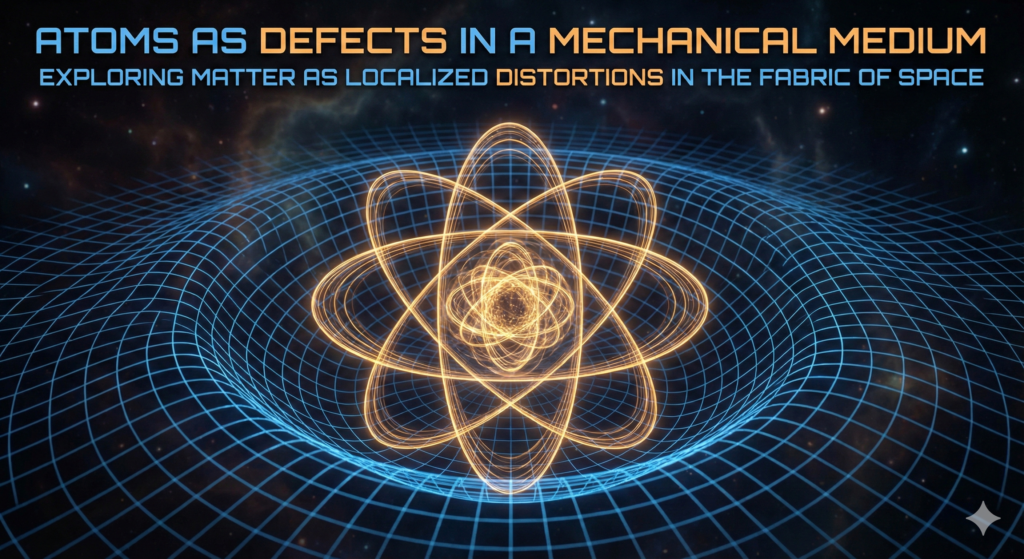
By now, two facts are clear:
- Atoms are defects, not waves
- Atomic shells close when mechanical nodes lock
What remains to be explained is the most visually striking feature of chemistry:
Why does the entire pattern repeat?
Why does nature not simply grow more complex without returning to familiar behaviors?
Why do reactivity, bonding, and structure cycle—again and again?
The answer is not numerical.
It is mechanical.
Repetition Is a Signature of Constraints, Not Coincidence
When a system repeats, it is almost never because of bookkeeping.
It repeats because it is being driven through the same constraint landscape multiple times.
In mechanical systems:
- strings repeat nodes along their length,
- resonators repeat modes with scale,
- elastic media repeat admissible closures as size increases.
The periodic table exhibits exactly this behavior.
Each Period Is a Traversal, Not an Accumulation
A chemical period is not a growing list of ingredients.
It is a traversal through a fixed set of admissible deformation environments.
As a defect accumulates additional circulation or coupling:
- stress redistributes outward,
- new envelopes become accessible,
- deformation channels open sequentially.
Eventually, a nodal lock is reached—and the traversal ends.
The next period begins only because the system is forced into a new scale where the same constraints reappear.
Why Scale Matters
The medium’s constitutive laws do not change between periods.
What changes is:
- the effective size of the defect,
- the radius at which stress closes,
- and the scale at which admissible envelopes form.
This produces repetition with variation:
- similar behaviors recur,
- but with increasing complexity,
- and different absolute energies.
The same rules are being applied—just farther out.
Period Length Is Not Arbitrary
The lengths of periods are often treated as mysterious numbers.
Mechanically, they reflect:
- how many admissible stress envelopes exist before node locking,
- given the medium’s stiffness and continuity,
- at a particular scale.
Different periods have different lengths because:
- admissible configurations proliferate with radius,
- before closure becomes inevitable again.
This is why early periods are short and later ones are long—without invoking numerology.
Why the Table Looks Like a Wave
If you plot chemical behavior across a period:
- reactivity rises,
- peaks,
- falls,
- and resets.
This is not metaphorical.
It reflects a cycle of mechanical admissibility:
- increasing deformation,
- increasing instability,
- followed by enforced closure.
The table looks like a wave because it is one—traced not in space, but in configuration space.
Why There Is No End to the Pattern (In Principle)
As long as the medium:
- supports larger defects,
- admits new envelopes at larger scales,
- and enforces node locking eventually,
the pattern can repeat.
There is no need to assume a finite catalog of elements at the outset.
The limits, if any, arise from material failure, not abstract prohibition.
A Mechanical Summary of Periodicity
We can now say this precisely:
The periodic table repeats because atoms are repeatedly driven through the same sequence of mechanically admissible configurations as defect scale increases.
Nothing is counted.
Nothing is memorized.
Nothing is imposed.
The medium enforces the pattern.
Key Takeaway
Periodicity is not a property of matter—it is a property of the medium.
Atoms repeat in behavior because the same mechanical constraints reassert themselves at every scale.
With periodicity understood, the next question becomes unavoidable:
Why does rotation and angular momentum appear everywhere in atomic behavior—and why can it never be turned off?
That question leads directly to spin.