
Why Energy Levels Are Quantized
SERIES IX — ATOMS AS DEFECTS IN A MECHANICAL MEDIUM
Why the Periodic Table Looks Like a Standing Wave
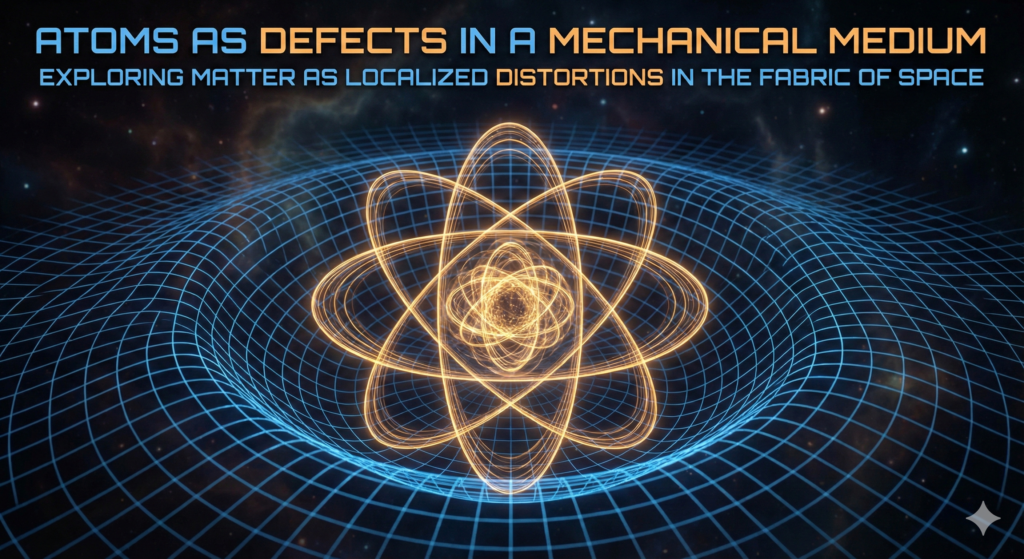
Once atoms are understood as circulating defects constrained by the medium, one of the most distinctive features of atomic behavior comes into focus:
Atoms do not change energy continuously.
They absorb and emit energy in discrete amounts.
They jump.
This behavior is usually presented as an axiom of quantum mechanics.
Mechanically, it is a consequence.
Continuous Change Would Destroy Stability
A stable defect exists only as long as:
- stress circulation remains closed,
- coupling to the medium remains balanced,
- and restoring forces remain intact.
Most small deformations are not allowed.
If a defect attempted to change its energy continuously:
- circulation would no longer close,
- stress would leak into propagating waves,
- and the configuration would destabilize.
Only certain reconfigurations preserve defect integrity.
Admissible Configurations Are Discrete
From the medium’s point of view, the defect does not have a continuum of options.
It has:
- stable configurations,
- unstable configurations,
- and nothing in between.
Standing-wave modes of the surrounding medium:
- define which stress envelopes can exist,
- determine which circulation patterns close,
- and forbid intermediate states.
This creates a discrete set of admissible energy levels.
Why Transitions Are Abrupt
A transition between two stable configurations requires:
- breaking one closure pattern,
- passing through an unstable regime,
- and re-locking into another admissible state.
The intermediate configurations are not sustainable.
As a result:
- transitions occur rapidly,
- energy is released or absorbed as waves,
- and the system does not linger between states.
The “quantum jump” is not mysterious—it is mechanically enforced.
Why Only Specific Energies Appear
Each allowed configuration corresponds to:
- a specific circulation pattern,
- a specific stress distribution,
- and therefore a specific energy content.
The difference between two admissible states is fixed.
When energy is exchanged:
- it must match that difference,
- or the transition cannot complete.
This is why atomic spectra consist of sharp lines, not smears.
Why Energy Is Conserved Without Tracking a Path
Quantum mechanics often avoids describing how transitions occur, focusing instead on probabilities.
Mechanically, the picture is clear:
- energy is temporarily stored in deformation,
- then released into propagating waves,
- with the medium enforcing conservation.
No hidden bookkeeping is required.
Why Temperature Does Not Smear Levels Away
Thermal agitation does not blur energy levels because:
- thermal fluctuations are too small to force reconfiguration,
- most perturbations are elastically absorbed,
- and only threshold-crossing disturbances trigger transitions.
Discrete levels persist even in noisy environments.
A Mechanical Interpretation of the Wavefunction
At this point, the wavefunction can be reinterpreted cautiously:
- it does not describe a physical wave,
- it maps admissible configurations,
- and it encodes how the medium constrains transitions.
Probability reflects accessibility, not indeterminism.
This will be expanded later—but the mechanical basis is already present.
Key Takeaway
Energy levels are quantized because only discrete defect configurations are mechanically admissible.
Continuous change would destroy the defect.
Abrupt transitions preserve it.
With quantization understood as a stability condition, one last question remains about atomic structure:
Why don’t atoms collapse inward—or fly apart—under their own stress?
That final question of stability is where we turn next.