
Why Atoms Don’t Collapse (or Fly Apart)
SERIES IX — ATOMS AS DEFECTS IN A MECHANICAL MEDIUM
Why the Periodic Table Looks Like a Standing Wave
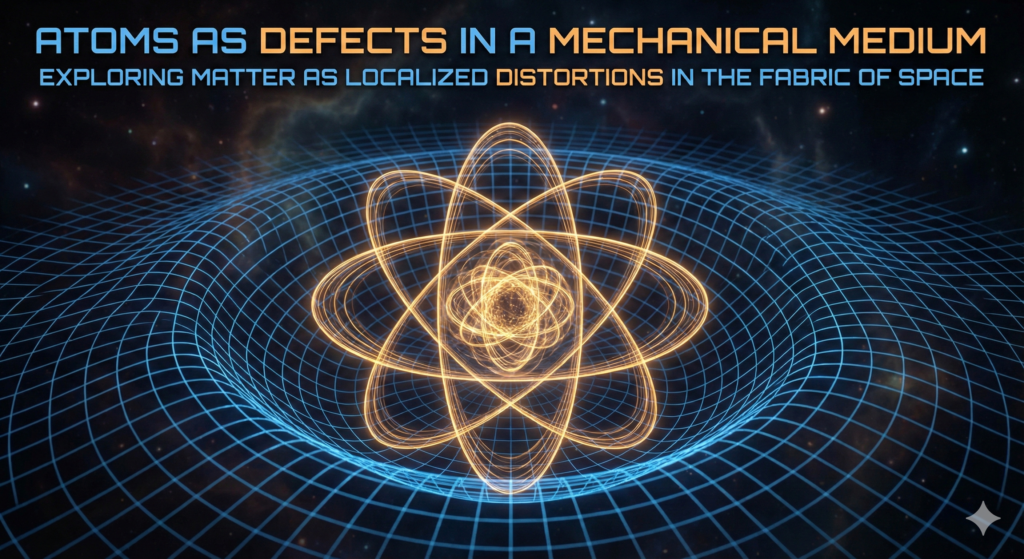
Once atoms are understood as circulating defects embedded in a mechanical medium, a final classical worry inevitably appears:
If there is inward stress, why doesn’t the atom collapse?
If there is circulation, why doesn’t it explode outward?
In conventional physics, this question is often answered with rules rather than reasons:
quantum uncertainty, exclusion principles, or postulated potentials.
In a mechanical picture, stability is not postulated.
It is enforced.
Collapse and Explosion Are Both Instabilities
In any material system, there are two generic failure modes:
- Collapse — inward stress overwhelms restoring response
- Explosion — outward motion exceeds confining stiffness
Stable structures exist only when these tendencies balance dynamically.
Atoms are no exception.
The Defect Is Held Open by Motion
A toroidal defect is not a static hole.
It is a circulating stress–flow configuration.
- Circulation produces centrifugal pressure
- The surrounding medium supplies inward tension
- Neither dominates permanently
The atom exists in a dynamic equilibrium, not a static one.
If circulation slows:
- the defect shrinks,
- restoring stresses increase,
- circulation is reinforced.
If circulation increases:
- coupling rises,
- energy radiates away as waves,
- excess motion is shed.
This is self-regulating behavior.
Why Inward Collapse Stops
Collapse would require the medium to:
- eliminate circulation,
- erase topological closure,
- and absorb stress discontinuously.
But topological defects cannot be removed smoothly.
They can only:
- annihilate with an opposite defect,
- or undergo a phase transition.
As long as the defect exists, complete collapse is mechanically forbidden.
Why Outward Explosion Stops
Explosion would require:
- continuous outward expansion,
- increasing coupling to the medium,
- and unbounded energy intake.
But as the defect expands:
- stiffness gradients increase,
- wave emission rises sharply,
- dissipation dominates.
The medium acts as a brake.
Energy leaks away faster than expansion can grow.
Quantization Reappears as Stability Windows
This explains why only certain sizes and energies are stable.
Between admissible configurations:
- restoring forces are unbalanced,
- radiation dominates,
- the structure cannot persist.
The atom therefore occupies:
- discrete equilibrium states,
- separated by unstable regions.
Quantized energy levels are stability windows, not arbitrary rules.
No Singularities, No Infinite Forces
Because the atom is extended and dynamic:
- no point charges exist,
- no infinite self-energies arise,
- no singular forces are required.
Everything is regulated by:
- stiffness,
- flow,
- and topology.
This alone resolves many pathologies of point-particle models.
Why Atoms Are Remarkably Robust
Atoms survive:
- intense fields,
- thermal agitation,
- radiation exposure,
- and mechanical disturbance,
because they are not rigid objects.
They are self-healing configurations of a medium that strongly resists discontinuity.
Key Takeaway
Atoms do not collapse or explode because they are dynamically stabilized defects, not static objects.
Inward stress, outward circulation, and radiative loss continuously rebalance.
Stability is not mysterious.
It is mechanical.
Closing the Series
With this post, the arc of Series IX — Recomputing Physics from First Mechanics closes:
- Matter as defect
- Energy as configuration
- Quantization as stability
- Atomic structure as constrained mechanics
What remains is not to invent new rules—but to apply these principles outward:
to materials, fields, anomalies, and experiments.
That expansion begins next.