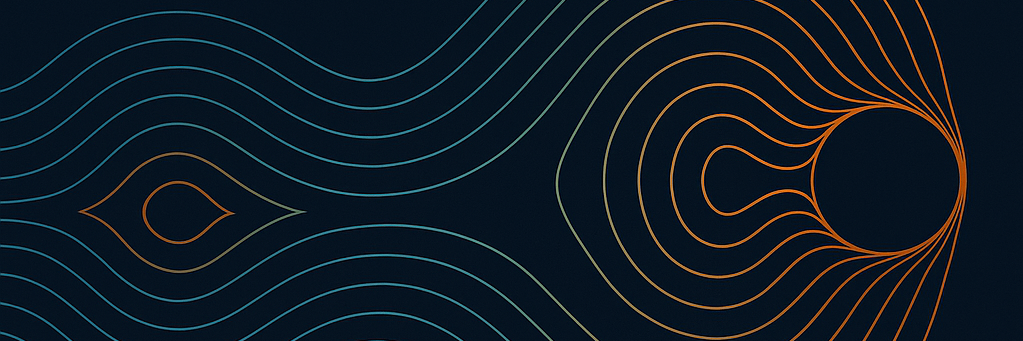
Orbital Speed from Stress Balance, Not Attraction
SERIES X — RECOMPUTING PHYSICS FROM FIRST MECHANICS
What Can Be Derived from Density & Stiffness Alone?
If gravity is not a force pulling inward, and escape is not about overcoming attraction, then a deeper question follows:
What does it mean to orbit at all?
In the standard picture, an orbit exists because an inward gravitational force is continuously balanced by outward inertial motion.
In a mechanical-medium picture, that language is unnecessary.
An orbit is a neutral stress trajectory.
The Conventional Formula, Reinterpreted
Orbital speed is usually written as
This is often read as:
“The speed needed so centripetal force matches gravitational pull.”
Mechanically, the same equation emerges from a very different requirement:
the speed at which a moving defect experiences no net stress imbalance.
Inward Stiffness Gradients
From Series X.1, gravity is a radial stiffness gradient produced by internal stress.
Near a massive body:
- the medium is more compressed,
- wave speeds are altered,
- restoring responses are stronger.
A stationary defect will drift “down” this gradient—what we call falling.
Motion Produces Outward Resistance
When a defect moves laterally through a stiffness gradient:
- it resists redirection due to inertia,
- circulation interacts asymmetrically with the medium,
- outward stress appears as a geometric effect.
This is not a force—it is resistance to curvature of motion.
Orbit as Stress Equilibrium
An orbit occurs when:
- inward stiffness gradient
- is exactly balanced by
- outward inertial resistance to bending the trajectory.
At that speed, the defect follows a path where:
- stress gradients are tangential,
- no net radial reconfiguration occurs,
- and the medium does not demand correction.
This is why orbits persist without continuous adjustment.
Why the Speed Is Exactly What It Is
The balance condition is:
Using the mechanical result from Series X.1:
gives:
The familiar formula survives because:
- it encodes a balance condition,
- not a force law.
Why Circular Orbits Are Special
Circular orbits are not privileged because they are simple.
They are special because:
- stress balance is uniform,
- no radial oscillation is required,
- and energy exchange with the medium is minimized.
Elliptical orbits correspond to:
- periodic excursions through slightly imbalanced regions,
- with energy traded back and forth as waves.
Nothing mysterious is happening—just stress redistribution.
Why Orbits Decay (or Don’t)
If the medium were perfectly elastic:
- orbits would persist indefinitely.
In reality:
- small dissipation exists,
- wave emission slowly drains energy,
- and orbits can decay over very long timescales.
This explains:
- atmospheric drag,
- tidal evolution,
- orbital circularization,
without invoking additional forces.
No Action-at-a-Distance Required
At no point does anything “reach out” to pull the orbiting body.
The medium:
- locally enforces stress compatibility,
- responds to motion,
- and guides trajectories naturally.
An orbit is simply the path of least mechanical resistance.
Key Takeaway
Orbital motion is not sustained by attraction—it is maintained by stress balance in a stiffness gradient.
The orbital speed is the speed at which inward and outward mechanical responses cancel.
With orbits understood this way, the next question becomes practical and tangible:
Why do large bodies become spherical, while small ones remain lumpy—and what sets the boundary between them?
That is where we turn next.