Asymmetric Capacitors and Stiffness Gradients
SERIES VI — ENGINEERING THE VACUUM
The Effective Medium View
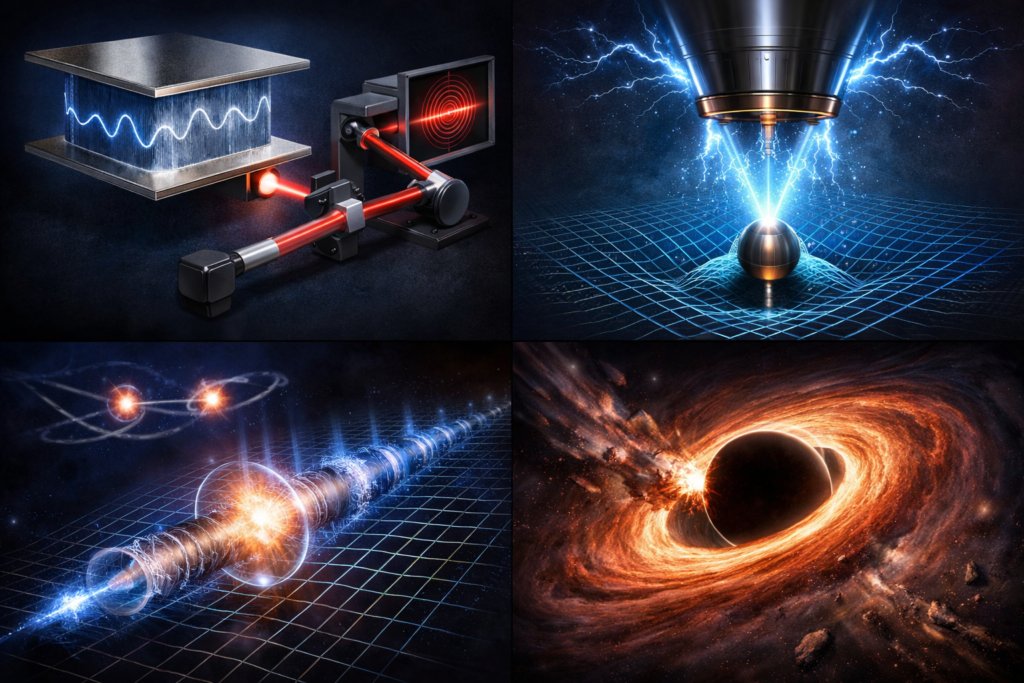
Asymmetric capacitors appear frequently in discussions of anomalous forces. Claims range from subtle thrust effects to outright propulsion without reaction mass. Most of these claims fail under experimental scrutiny, often because mundane effects—ion wind, thermal gradients, leakage currents—were not fully controlled.
This post does something more limited and more useful:
It asks what would have to be true, mechanically, for an asymmetric electric structure to produce a net force in a medium.
The goal is not validation. It is falsifiable framing.
Start With What Is Not in Dispute
When an electric field is applied across a dielectric:
- charges polarize,
- elastic energy is stored,
- and electrostatic pressure appears.
This pressure is not speculative. It is a direct consequence of the Maxwell stress tensor, and it acts on materials at boundaries and interfaces.
If everything is symmetric, forces cancel.
Asymmetry is therefore not a curiosity—it is a requirement.
What “Asymmetric” Actually Means
Asymmetry does not mean:
- different plate shapes alone,
- unequal voltages,
- or clever wiring.
Mechanically, asymmetry means non-uniform stress response.
This can arise from:
- layered dielectrics with different stiffness,
- gradients in permittivity,
- spatially varying polarization response,
- or geometries that concentrate field lines unevenly.
Only these conditions can produce a net stress gradient.
Stiffness Gradients, Not Field Strength
A crucial distinction must be made.
High electric fields increase stored energy.
They do not automatically create force.
Force appears only when the field modifies the medium’s response unevenly.
In effective-medium terms:
- the field alters local stiffness,
- stiffness gradients redirect stress,
- and stress gradients act on boundaries.
Without a stiffness gradient, nothing moves.
Why Many Experiments Fail
Most reported asymmetric-capacitor effects fail because:
- fields are strong but symmetric,
- dielectric response is uniform,
- or parasitic effects dominate measurements.
When force is observed, it often disappears when:
- air is removed,
- thermal effects are controlled,
- or measurement geometry is inverted.
These failures are not discouraging. They are informative.
They tell us that field energy alone is insufficient.
What Would Count as Evidence
Within this framework, meaningful evidence would require:
- operation in high vacuum,
- elimination of ionic and thermal artifacts,
- symmetric electrical drive with asymmetric constitutive response,
- and force scaling with dielectric configuration, not current or power.
Such experiments are difficult—but not ill-defined.
Importantly, null results would constrain the model sharply.
Relation to Prior Work
Electrostatic pressure and dielectric stress have been studied for over a century, from early capacitor experiments to modern MEMS devices. Researchers such as Oliver Heaviside and James Clerk Maxwell recognized that fields exert mechanical stress long before speculative applications arose.
This post does not extend their conclusions. It applies them carefully.
What This Does—and Does Not—Claim
This post does not claim:
- that asymmetric capacitors produce thrust,
- that reactionless propulsion exists,
- or that past experiments were misinterpreted maliciously.
It does claim:
- that force requires stress gradients,
- that stiffness gradients are the relevant quantity,
- and that geometry and materials matter more than voltage.
If no stiffness gradient can be produced, the idea fails cleanly.
Why This Matters
By framing the problem mechanically:
- speculative claims become testable,
- failure modes become obvious,
- and experimental design improves.
Whether the outcome is null or non-null, the result advances understanding.
In the next post, we turn to a phenomenon that already demonstrates vacuum sensitivity—without controversy—and ask whether it can act as a constitutive probe.
Next:
→ Casimir Cavities as Constitutive Probes