
Could the Vacuum Have Structure Without Chemistry?
SERIES VII — LIVING IN A SOLID VACUUM
How Motion, Freedom, and Transparency Are Possible
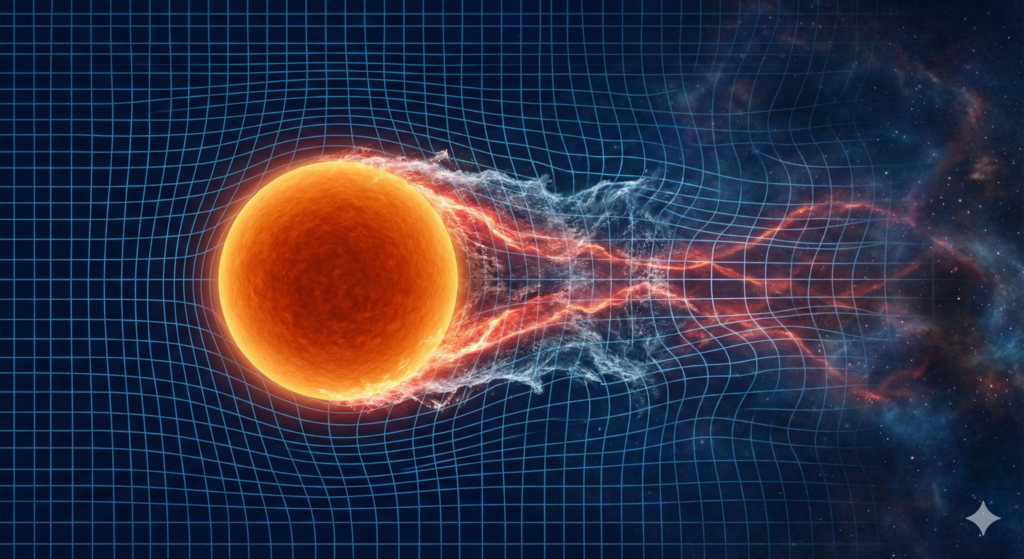
Speculative, Optional Reading
Up to this point, nothing in the argument has required the vacuum to be made of anything.
We have only required that it behave like a real medium:
- capable of supporting shear,
- able to reorganize stress,
- transparent to uniform motion,
- and responsive only under specific regimes.
That alone is enough to explain motion, inertia, light, and relativity.
But once regime separation is on the table, a new—and natural—question appears:
Could a medium behave this way without any internal structure at all?
This post explores one possible answer.
It is not required for the framework to function.
Structure Does Not Require Particles
In mechanics, “structure” does not mean particles, grains, or constituents in the usual sense.
A violin string has structure.
A crystal lattice has structure.
A standing wave in a cavity has structure.
None of these require discrete objects moving independently. They require only:
- boundary conditions,
- stiffness,
- and allowed modes.
A medium can be fully continuous and still exhibit organized internal modes.
Saturated Modes and Invisible Structure
Consider a system whose lowest modes are already fully occupied.
In such a system:
- No additional defects can localize
- No chemistry can occur
- No energy can be extracted locally
- Only global support remains
To an observer embedded within it, the medium would appear:
- perfectly smooth,
- inert,
- and empty
Not because nothing is there—but because nothing can be individuated.
This is one way a medium can be real yet experientially invisible.
A Harmonic Threshold for “Things”
One speculative way to think about this is in terms of harmonic bands.
Below a certain threshold:
- Standing waves exist
- Stress is supported
- Constraints propagate
- But localized, persistent defects do not
Above that threshold:
- Partial closure becomes possible
- External coupling appears
- Chemistry begins
- “Things” can exist
In this view, matter is not fundamental.
It is permitted.
Russell’s Intuition (Contextual, Not Doctrinal)
This idea echoes an intuition explored by Walter Russell, who proposed that the familiar chemical elements occupy only a higher set of harmonic “octaves,” with several lower octaves existing beneath chemistry.
Stripped of metaphysical claims, the mechanically relevant part of that intuition is simple:
The periodic table may be cataloging allowed standing-wave closures, not fundamental substances.
In that language:
- Chemistry begins only when certain modes become externally accessible
- Lower modes may exist but remain saturated and non-interactive
This alignment is structural, not philosophical.
Why Such Structure Would Be Undetectable
If lower-order modes are:
- fully occupied,
- extremely stiff,
- and incapable of defect individuation,
then they would:
- carry shear and constraint,
- set wave speeds,
- enforce consistency,
without ever appearing as particles, fields, or signals.
They would function as substrate, not content.
Nothing in ordinary experiments would couple to them directly.
What This Does Not Claim
It’s important to be explicit:
- This framework does not require lower-octave constituents
- It does not claim Russell’s model is correct
- It does not introduce new particles or forces
It simply notes that structured behavior without chemistry is mechanically admissible.
That possibility exists whether or not any specific historical model captures it accurately.
Why This Idea Is Being Introduced Here
Only now—after motion, inertia, and regime separation are understood—does this question make sense.
Earlier, it would have sounded speculative or unnecessary.
Now, it feels like a reasonable extension:
If the vacuum behaves like a medium with regimes, perhaps it also has modes that lie below the threshold of matter itself.
That question is optional—but it is no longer arbitrary.
Key Takeaway
A medium can be real, structured, and dynamically essential without being chemically populated.
Whether the vacuum does have such substructure remains an open question.
But the mechanical framework leaves room for it—without needing it.
With this, we close Series VII.
So far, we have asked how it behaves.
Next, we turn to the deeper—and more optional—question:
If the medium has structure, what could that structure look like?
That is the territory of the next series.