Dark Energy and the Cost of Propagation
SERIES V — ANOMALIES & REINTERPRETATIONS
When Description Is Mistaken for Reality
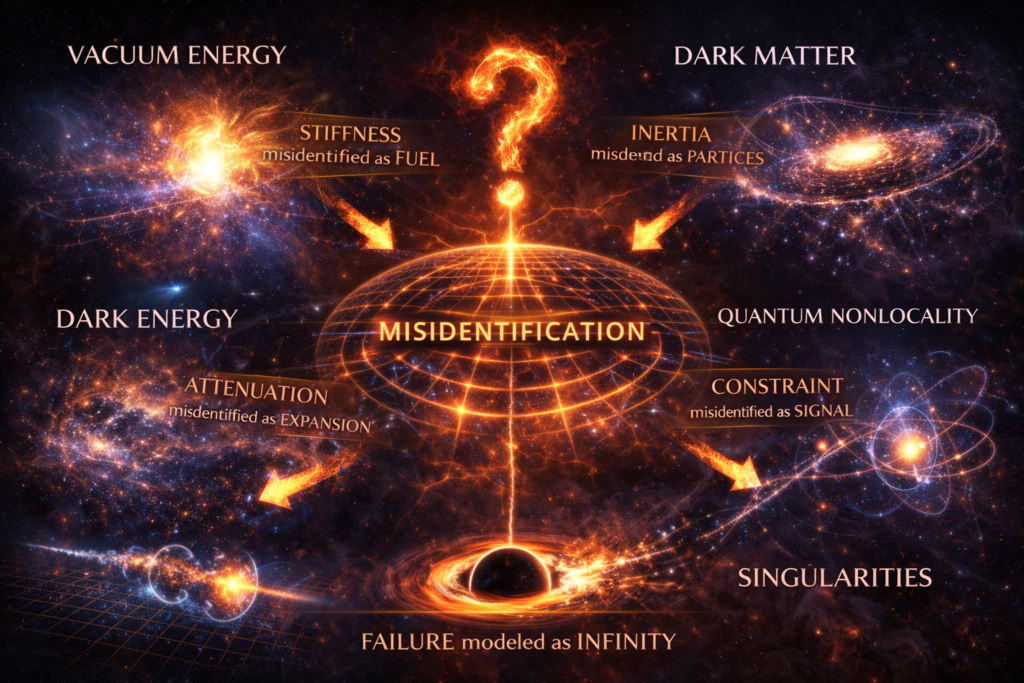
Dark energy is invoked to explain one observation: distant galaxies appear to be receding faster than expected, as inferred from the redshift of their light. The standard interpretation is that cosmic expansion is accelerating, driven by an unknown energy component that dominates the universe.
This post explores a different possibility:
What if part of the observed redshift reflects the cost of wave propagation through a real medium, rather than accelerated expansion of space itself?
This is not a return to discarded ideas. It is a careful re-examination of assumptions.
What Is Actually Measured
The primary evidence for dark energy comes from observations of distant supernovae. Their light appears:
- redshifted more than expected,
- dimmer than predicted by simple expansion models,
- and consistent across large samples.
What is measured directly is frequency shift and intensity, not expansion rate. Expansion is inferred by assuming that redshift arises only from kinematic recession.
That assumption deserves scrutiny.
Propagation Is Never Free in Materials
In every physical medium we understand, wave propagation has a cost.
- Energy is temporarily stored and released.
- Phase is delayed relative to free travel.
- Small losses accumulate over long distances.
In viscoelastic materials, these effects are subtle locally but significant over many wavelengths.
If light propagates through a medium with even minute dissipative or dispersive properties, then:
- frequency shifts can accumulate,
- amplitudes can decrease,
- and travel time can increase—
without requiring any change in source motion.
Redshift Without Expansion
A mechanical medium allows for propagation-induced redshift.
This does not mean light “loses energy” arbitrarily. It means that:
- part of the wave’s energy is stored elastically,
- part is exchanged with the medium,
- and phase evolution differs slightly from idealized vacuum propagation.
Over cosmological distances, even vanishingly small effects become measurable.
This contribution would add to kinematic redshift, not replace it.
Why Acceleration Is a Strong Claim
Accelerated expansion is not a local measurement. It is a global inference that depends on:
- assuming perfect transparency of the vacuum,
- assuming no propagation losses,
- and assuming redshift has a single cause.
In mechanics, such assumptions are rarely justified.
Before introducing a new energy component that dominates the universe, it is reasonable to ask whether a known physical process—wave propagation through a medium—has been fully accounted for.
The Vacuum as a Load-Bearing Medium
In the mechanical vacuum framework:
- the vacuum stores elastic energy,
- supports shear waves,
- and enforces constraints.
These are precisely the properties that, in materials, lead to dispersion and attenuation.
Calling the vacuum “empty” does not make these effects vanish. It simply hides them behind abstraction.
Why This Is Not “Tired Light”
Historically, simple “tired light” models failed because they:
- predicted image blurring,
- violated surface brightness relations,
- or conflicted with time-dilation observations.
The mechanism discussed here is different.
- It is elastic, not frictional.
- It preserves coherence and image sharpness.
- It operates through phase evolution, not random scattering.
Any viable contribution must satisfy existing observational constraints. This framework does not exempt itself from that requirement.
What This Does—and Does Not—Claim
This post does not claim:
- that cosmic expansion is illusory,
- that dark energy is disproven,
- or that a single mechanism explains all redshift.
It does claim:
- that propagation effects deserve consideration,
- that acceleration is an inference, not a direct measurement,
- and that medium properties can masquerade as cosmological dynamics.
This is a reinterpretation, not a rejection.
Why This Matters
If part of the redshift budget arises from propagation:
- the required dark energy density decreases,
- cosmic acceleration may be overestimated,
- and the vacuum’s constitutive properties become measurable through astronomy.
The anomaly shifts from “missing energy” to unmodeled mechanics.
In the next post, we turn to another place where infinities appear—and ask whether they, too, arise from treating a descriptive quantity as a physical substance.
Next:
→ Black holes are often presented as the ultimate breakdown of physics: regions where density becomes infinite, spacetime curvature diverges, and known laws cease to apply. These conclusions follow rigorously from the mathematics—but they also signal something familiar to engineers:
When a model predicts infinities, it is usually being applied beyond its material limits.
This post reframes black holes not as singularities of nature, but as failure zones in a stressed medium.
What the Mathematics Really Says
Solutions such as the Karl Schwarzschild metric predict two notable features:
- an event horizon, where signals can no longer escape,
- and a singularity, where curvature formally diverges.
The equations do not say that infinity is physically real. They say that the geometric description no longer tracks what the system is doing.
In mechanics, this is a warning—not a revelation.
How Materials Actually Fail
In real materials under extreme stress:
- elastic behavior holds up to a point,
- stiffness decreases as strain increases,
- beyond a threshold, the material can no longer support shear.
When that happens, one of two things occurs:
- fracture, where the medium separates, or
- cavitation, where a void forms and shear support collapses.
Neither process involves infinite density or force.
Both involve the loss of load-bearing capacity.
Translating This to Gravity
Within the mechanical vacuum framework, gravity corresponds to a tension state supported by the medium’s stiffness.
As gravitational stress increases:
- stiffness decreases,
- wave speeds drop,
- and the medium’s ability to transmit shear is progressively lost.
The event horizon marks the boundary where:
- shear waves (including light) can no longer propagate outward,
- not because they are forbidden,
- but because the medium can no longer support them.
This is a material transition, not a geometric miracle.
The Meaning of the Event Horizon
From this perspective, the event horizon is not a place where “space ends.”
It is a failure boundary.
Outside the boundary:
- the medium supports shear,
- signals propagate,
- geometry remains a useful descriptor.
Inside the boundary:
- shear support collapses,
- transverse propagation fails,
- and the geometric description breaks down.
Nothing needs to be infinite for this to occur.
What About the Singularity?
The singularity appears when geometry is pushed past the point where the medium description applies.
In mechanics, we do not conclude that stress is infinite at a crack tip. We conclude that the continuum approximation has failed and that new physics—fracture, cavitation, phase change—must take over.
The same logic applies here.
The “singularity” is not a thing.
It is a model failure indicator.
Accretion, Jets, and Observations
Observational features associated with black holes—accretion disks, relativistic jets, intense radiation—occur outside the failure zone.
They are consistent with:
- extreme but finite stresses,
- strong stiffness gradients,
- and intense energy flow in the surrounding medium.
Nothing observed requires infinite density or exotic states of matter.
Why This Reframing Helps
Viewing black holes as material failure zones:
- removes the need for physical infinities,
- preserves all external predictions of relativity,
- clarifies why horizons behave as one-way boundaries,
- and aligns gravitational collapse with known material behavior.
Geometry remains useful—up to the point where it stops working.
What This Does—and Does Not—Claim
This post does not claim:
- that black holes are harmless,
- that collapse is illusory,
- or that General Relativity is wrong.
It does claim:
- that singularities are not physical objects,
- that horizons mark constitutive limits,
- and that gravity should be interpreted as material stress, not abstract curvature.
Why This Matters
If black holes are material failure zones:
- quantum gravity problems become constitutive problems,
- information paradoxes lose their footing,
- and the focus shifts from infinities to phase transitions.
In the next post, we apply the same reasoning to a different kind of infinity—one that appears not in stars, but in empty space itself.
Next:
→ Black holes are often presented as the ultimate breakdown of physics: regions where density becomes infinite, spacetime curvature diverges, and known laws cease to apply. These conclusions follow rigorously from the mathematics—but they also signal something familiar to engineers:
When a model predicts infinities, it is usually being applied beyond its material limits.
This post reframes black holes not as singularities of nature, but as failure zones in a stressed medium.
What the Mathematics Really Says
Solutions such as the Karl Schwarzschild metric predict two notable features:
- an event horizon, where signals can no longer escape,
- and a singularity, where curvature formally diverges.
The equations do not say that infinity is physically real. They say that the geometric description no longer tracks what the system is doing.
In mechanics, this is a warning—not a revelation.
How Materials Actually Fail
In real materials under extreme stress:
- elastic behavior holds up to a point,
- stiffness decreases as strain increases,
- beyond a threshold, the material can no longer support shear.
When that happens, one of two things occurs:
- fracture, where the medium separates, or
- cavitation, where a void forms and shear support collapses.
Neither process involves infinite density or force.
Both involve the loss of load-bearing capacity.
Translating This to Gravity
Within the mechanical vacuum framework, gravity corresponds to a tension state supported by the medium’s stiffness.
As gravitational stress increases:
- stiffness decreases,
- wave speeds drop,
- and the medium’s ability to transmit shear is progressively lost.
The event horizon marks the boundary where:
- shear waves (including light) can no longer propagate outward,
- not because they are forbidden,
- but because the medium can no longer support them.
This is a material transition, not a geometric miracle.
The Meaning of the Event Horizon
From this perspective, the event horizon is not a place where “space ends.”
It is a failure boundary.
Outside the boundary:
- the medium supports shear,
- signals propagate,
- geometry remains a useful descriptor.
Inside the boundary:
- shear support collapses,
- transverse propagation fails,
- and the geometric description breaks down.
Nothing needs to be infinite for this to occur.
What About the Singularity?
The singularity appears when geometry is pushed past the point where the medium description applies.
In mechanics, we do not conclude that stress is infinite at a crack tip. We conclude that the continuum approximation has failed and that new physics—fracture, cavitation, phase change—must take over.
The same logic applies here.
The “singularity” is not a thing.
It is a model failure indicator.
Accretion, Jets, and Observations
Observational features associated with black holes—accretion disks, relativistic jets, intense radiation—occur outside the failure zone.
They are consistent with:
- extreme but finite stresses,
- strong stiffness gradients,
- and intense energy flow in the surrounding medium.
Nothing observed requires infinite density or exotic states of matter.
Why This Reframing Helps
Viewing black holes as material failure zones:
- removes the need for physical infinities,
- preserves all external predictions of relativity,
- clarifies why horizons behave as one-way boundaries,
- and aligns gravitational collapse with known material behavior.
Geometry remains useful—up to the point where it stops working.
What This Does—and Does Not—Claim
This post does not claim:
- that black holes are harmless,
- that collapse is illusory,
- or that General Relativity is wrong.
It does claim:
- that singularities are not physical objects,
- that horizons mark constitutive limits,
- and that gravity should be interpreted as material stress, not abstract curvature.
Why This Matters
If black holes are material failure zones:
- quantum gravity problems become constitutive problems,
- information paradoxes lose their footing,
- and the focus shifts from infinities to phase transitions.
In the next post, we apply the same reasoning to a different kind of infinity—one that appears not in stars, but in empty space itself.
Next:
→ Black Holes as Material Failure Zones