Gravity Without Geometry
SERIES II — GRAVITY & RELATIVITY
Stress, Not Curvature
Gravity is one of the most precisely tested phenomena in physics—and one of the least mechanically explained.
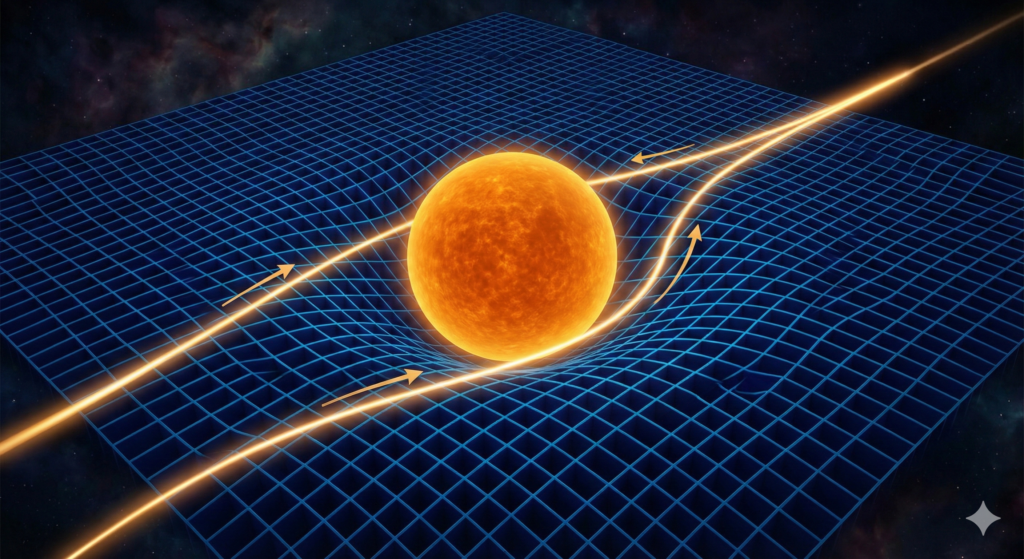
General Relativity describes gravity as the curvature of spacetime, a geometric prescription introduced by Albert Einstein that has passed every experimental test to date. Yet despite its success, the theory leaves an unanswered question quietly in the background:
What is actually being curved?
This post does not dispute relativity’s predictions. Instead, it asks whether those predictions can be understood as the response of a physical medium rather than as geometry acting without a substrate.
Geometry as Description, Not Cause
In physics, geometry is often a powerful shorthand.
- In optics, curved ray paths describe refraction.
- In fluid mechanics, streamlines describe flow.
- In elasticity, deformed coordinates describe strain.
In none of these cases does geometry cause motion. It summarizes how something physical responds.
This blog takes the position that spacetime geometry may play the same role for gravity: an effective description of how signals and trajectories behave inside a stressed medium.
A Mechanical View of Attraction
In ordinary materials, attraction does not arise from curvature. It arises from stress gradients.
- Objects accelerate toward regions of lower pressure.
- Tension draws material inward.
- Gradients, not absolute values, drive motion.
This is a crucial mechanical principle:
Nothing moves because of geometry alone; it moves because stress is uneven.
If gravity is attractive, then some form of tension or stress imbalance must be present—regardless of how it is mathematically described.
Mass as a Source of Stress
Within the mechanical vacuum framework, mass is treated not as a point that “pulls,” but as a persistent source of radial tension in the surrounding medium.
Intuitively:
- A stable defect (matter) must be supported by continuous stress.
- Maintaining that configuration requires inward momentum flow.
- The surrounding medium experiences a state of rarefaction—tension rather than compression.
This tension is not a force acting at a distance. It is a local mechanical condition.
Why Curvature Works So Well
If waves and objects propagate through a medium whose properties vary with position, their paths will bend.
In optics, this is called refraction.
In elasticity, it is called stress-guided propagation.
General Relativity captures this behavior geometrically by encoding it into the metric. That approach is extraordinarily efficient—and entirely compatible with a mechanical interpretation.
The key point is this:
Curved trajectories do not require curved space; they require spatially varying response.
Geometry works because it tracks the outcome, not because it is the underlying cause.
Light Bending Without Bending Space
One of the classic tests of gravity is the bending of light near massive objects.
In a mechanical medium:
- wave speed depends on local material properties,
- gradients in those properties cause refraction,
- rays bend toward regions of reduced wave speed.
This is exactly how light bends in glass or water.
From this perspective, gravitational lensing is not mysterious—it is the natural consequence of waves propagating through a stressed medium whose stiffness varies with position.
What Changes—and What Does Not
This reinterpretation changes how we think, not what we predict.
It does not claim:
- that General Relativity is wrong,
- that spacetime geometry is useless,
- or that new forces are required.
It does claim:
- that geometry is a diagnostic,
- that stress and stiffness are physical,
- and that gravity can be understood as a material response.
Every weak-field prediction of relativity remains intact.
Why This Matters
Recasting gravity as stress rather than geometry:
- restores mechanical intuition,
- aligns gravity with how forces arise elsewhere in physics,
- removes the need for action without mechanism,
- and prepares the ground for understanding anomalies later.
Most importantly, it gives us something concrete to ask about gravity:
What is the medium doing, and how does it respond?
In the next post, we will see that not all material properties contribute equally—and that one, in particular, dominates gravitational behavior.
Next:
→ Why Stiffness Matters More Than Density