If the Vacuum Is a Solid, Why Can We Move Through It?
SERIES VII — LIVING IN A SOLID VACUUM
How Motion, Freedom, and Transparency Are Possible
One of the first objections to any physical vacuum model is immediate and intuitive:
If space is a solid medium, shouldn’t moving through it feel like moving through rock? Or at least water?
This reaction is reasonable—and it comes from a hidden assumption: that solidity automatically implies resistance.
In mechanics, that assumption is false.
To understand why, we need to separate three ideas that are often conflated: stiffness, drag, and dissipation.
Solidity Does Not Mean Friction
A solid is defined by its ability to support shear stress, not by its tendency to resist motion.
- Rubber is solid, yet objects embedded in it can translate without resistance if the rubber moves with them.
- Ice is solid, yet glaciers flow.
- A crystal lattice is solid, yet defects inside it can migrate freely under the right conditions.
What produces drag is not solidity—it is dissipation.
Drag appears when motion continuously converts organized energy into heat.
A medium can be:
- Extremely stiff
- Perfectly solid
- And essentially frictionless
All at the same time.
Defects Do Not Move Through the Medium
A second misconception is the idea that matter travels through space the way a projectile travels through air.
In a mechanical-vacuum picture, this is backwards.
Matter is not an object inserted into space.
Matter is a structural defect of the medium itself.
When a defect moves, it does not plow through an external substance. Instead:
- The surrounding medium reorganizes around the defect.
- The defect is carried along by the local stress–flow configuration.
- No continual shearing or tearing is required.
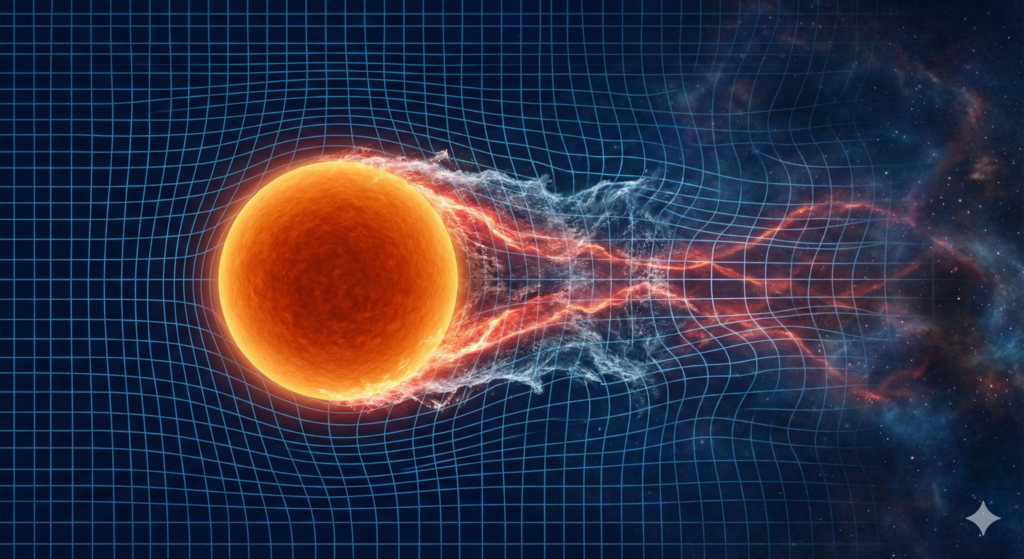
A helpful analogy is a vortex ring in a fluid. The ring moves coherently, yet the fluid itself does not experience bulk drag. The motion is self-supported by the structure of the flow.
Why No Energy Is Lost During Uniform Motion
In classical mechanics, resistance appears when motion continuously excites internal degrees of freedom—random molecular motion, turbulence, or plastic deformation.
In the vacuum medium:
- Uniform motion produces no sustained strain
- No strain means no energy loss
- No energy loss means no drag
Only changes in motion—accelerations—require the medium to reorganize stress. This distinction is crucial and will matter later when we discuss inertia.
Uniform motion is mechanically invisible.
Superfluid Behavior Is Not Exotic
This kind of behavior is not hypothetical. It already exists in known materials.
Superfluid helium supports:
- Flow without viscosity
- Persistent circulation
- Stable vortices that move without energy loss
A supersolid combines:
- Elastic stiffness (shear support)
- Frictionless defect motion
The constitutive vacuum behaves in exactly this way—but at vastly higher stiffness and vastly lower loss.
What This Resolves
Once this distinction is clear, several apparent paradoxes vanish:
- A solid vacuum does not imply drag
- Motion does not require continual force
- Objects do not grind against space
Instead, free motion is the default state of a low-loss mechanical medium.
Key Takeaway
A solid medium resists deformation, not motion.
As long as motion does not require continual deformation, it proceeds freely.
In the next post, we’ll push this idea further and ask a sharper question:
If the medium is real and stiff, why don’t we feel it at all—while light so clearly does?
That question turns out to have a precise mechanical answer.