Longitudinal Waves Are Not Forbidden
SERIES IV — ELECTROMAGNETISM, MODES & CONSTRAINTS
Fields as Stress–Flow
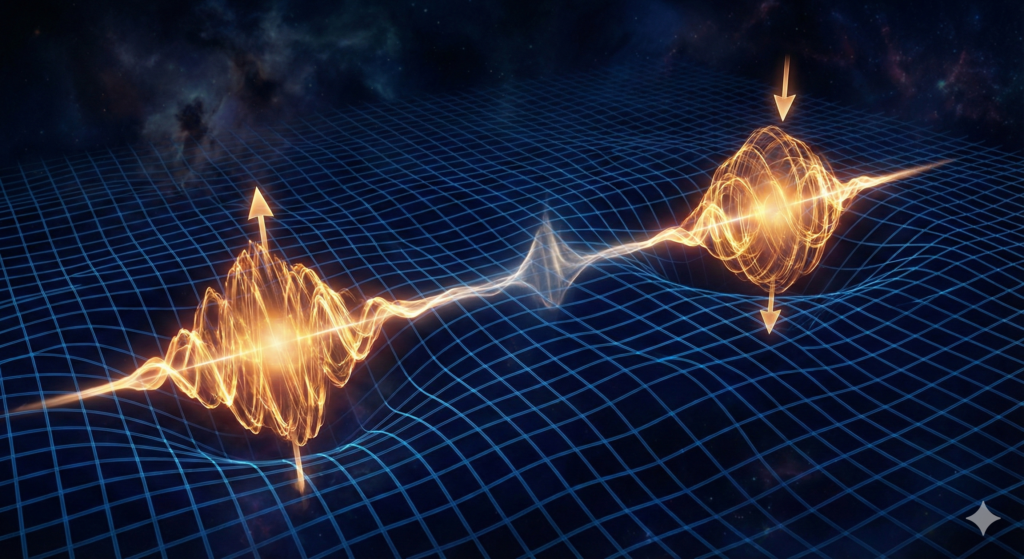
One of the quiet assumptions embedded in modern field theory is that only transverse waves matter. Electromagnetic radiation is transverse; gravitational waves are transverse; longitudinal modes are often treated as unphysical, redundant, or “gauged away.”
This post makes a precise corrective statement:
Longitudinal responses are not forbidden by physics—they are excluded by model choice.
Once the vacuum is treated as a medium rather than an abstraction, their reappearance is unavoidable.
What “Longitudinal” Actually Means
A longitudinal disturbance is one in which motion or response occurs along the direction of propagation.
- Sound waves in air are longitudinal.
- Seismic P-waves are longitudinal.
- Compression waves in solids are longitudinal.
In these cases, material elements move back and forth along the direction the disturbance travels. This motion is governed by bulk stiffness—the resistance to compression.
Longitudinal behavior is not exotic. It is one of the most common responses in continuum mechanics.
Why Field Theory Excludes Them
In classical electromagnetism, longitudinal electric fields are allowed only in the presence of charges, while free-space radiation is strictly transverse. This is not because longitudinal modes are impossible, but because Maxwell’s equations were formulated for a specific purpose: describing energy-carrying radiation in an effectively incompressible setting.
In other words:
- the theory assumes away compressibility,
- removes constraint modes by construction,
- and focuses only on propagating degrees of freedom.
This is mathematically elegant—and physically incomplete.
Constraint Fields vs. Energy-Carrying Waves
The key distinction is this:
Not all field responses transport energy. Some enforce constraints.
In elastic media:
- transverse waves carry energy and momentum,
- longitudinal responses often act to preserve continuity,
- constraint enforcement can appear effectively instantaneous within the system.
These constraint fields do not violate causality because they cannot be independently modulated. They do not carry information. They simply ensure consistency.
This distinction resolves many apparent paradoxes.
The Nearly Incompressible Limit
If a medium is extremely stiff to compression but flexible in shear—a situation common in solids and superfluids—longitudinal responses propagate much faster than transverse ones.
In the limiting case:
- compressive response becomes global,
- constraint enforcement appears “immediate,”
- but no signal outruns energy propagation.
This is standard mechanics, not speculation.
If the vacuum is nearly incompressible, longitudinal constraint fields are expected—not forbidden.
Why We Rarely Notice Them
Longitudinal responses are difficult to detect because:
- they do not radiate energy outward,
- they do not produce polarization,
- they do not appear as independent signals.
Instead, they appear indirectly:
- as enforced correlations,
- as instantaneous-looking adjustments,
- as boundary-condition effects.
When misinterpreted, these behaviors are often labeled “nonlocal.”
Historical Context
Early electromagnetic theorists, including James Clerk Maxwell, were aware that field equations described stresses in a medium. Later, gauge formulations prioritized mathematical economy over mechanical completeness.
The exclusion of longitudinal modes was a pragmatic decision, not a discovery of impossibility.
That distinction matters.
What This Does—and Does Not—Claim
This post does not claim:
- that new radiation modes exist,
- that signals travel faster than light,
- or that Maxwell’s equations are wrong.
It does claim:
- that constraint responses are physically real,
- that they need not transport energy,
- and that ignoring them creates conceptual confusion.
Longitudinal behavior belongs to mechanics.
Its absence in some theories reflects focus, not prohibition.
Why This Matters Going Forward
Recognizing longitudinal constraint fields:
- clarifies Tesla’s language without mysticism,
- explains how global correlations can arise locally,
- and sets the stage for understanding quantum entanglement without signaling.
The next post applies this distinction directly to one of the most misunderstood concepts in modern physics.
Next:
→ Why Entanglement Is Not Information