
Shell Closure as Mechanical Node Locking
SERIES IX — ATOMS AS DEFECTS IN A MECHANICAL MEDIUM
Why the Periodic Table Looks Like a Standing Wave
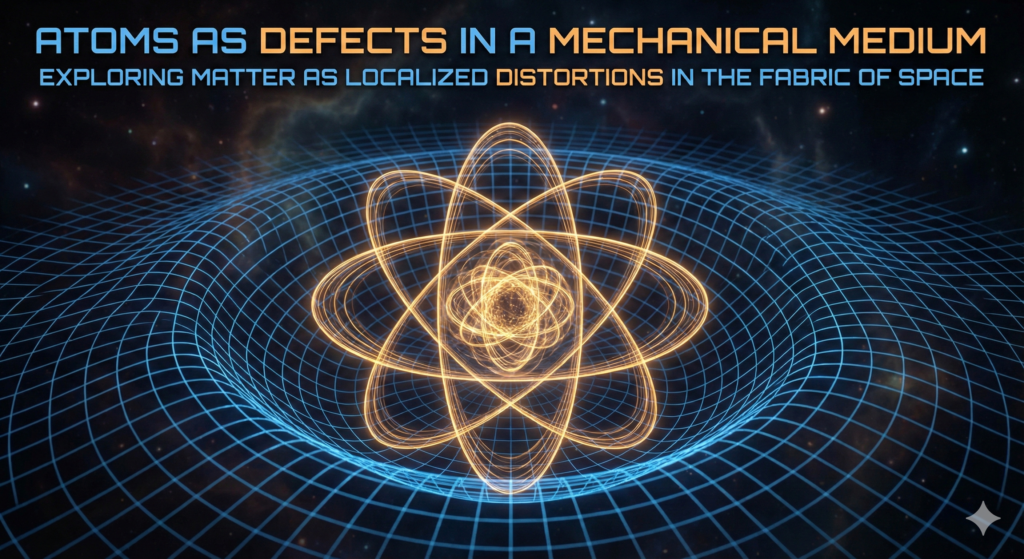
In the previous post, we saw why atomic shells exist: only certain stress envelopes are mechanically admissible around a stable defect.
Now we confront a sharper, more decisive question:
Why do shells abruptly close—and why does chemistry reset so dramatically when they do?
Why does gradual addition suddenly give way to inertness?
The answer lies in a specific mechanical event: node locking.
Closure Is Not Saturation by Accumulation
Shell closure is often described as a shell being “filled,” as though atoms were containers accumulating contents.
Mechanically, that picture is misleading.
Shells do not close because they are full.
They close because the medium reaches a nodal condition where further coupling becomes mechanically forbidden.
This is a qualitative change, not a quantitative one.
What a Node Means Mechanically
A node is not an empty point.
It is a location—or surface—where motion and coupling are suppressed by the medium’s constraints.
At a node:
- displacement vanishes,
- shear circulation cancels,
- net external coupling drops sharply.
When a shell reaches a nodal configuration, the surrounding medium becomes locally locked.
No additional stable deformation can attach there.
Why Noble Gases Are Mechanically Special
This is why noble gases behave the way they do.
They correspond to defect configurations where:
- all admissible stress envelopes are node-locked,
- circulation is internally balanced,
- and external deformation channels are closed.
Chemically, this appears as inertness.
Mechanically, it is minimum-coupling closure.
Nothing is “missing.”
Nothing needs to be added.
The configuration is simply complete.
Why the Next Element Is a Reset, Not an Extension
If shells merely filled gradually, chemistry would change smoothly.
Instead, after closure:
- adding even a small amount of additional coupling destabilizes the configuration,
- stress must reorganize globally,
- and a new admissible envelope opens at a larger radius.
This is why the next element in the table behaves radically differently.
The system does not continue—it restarts.
Node Locking Explains Periodic Sharpness
The sharp boundaries in the periodic table are not arbitrary.
They reflect:
- abrupt transitions between admissible and inadmissible configurations,
- enforced by the medium’s constitutive constraints,
- not by bookkeeping of particles.
This is why:
- reactivity peaks before closure,
- collapses at closure,
- and then re-emerges suddenly afterward.
The pattern is mechanical inevitability.
Why Closure Is Stable
Once a nodal configuration is reached:
- small perturbations are absorbed elastically,
- stress redistributes internally,
- no new attachment channels open.
This produces extraordinary stability.
You do not “almost” break a closed shell.
You must push the system hard enough to force a new regime entirely.
A Mechanical Definition of an Element
At this point, we can state something precise:
An element is a stable defect configuration whose surrounding stress envelopes are either open (reactive) or node-locked (inert).
Periodicity arises because:
- admissible envelopes are discrete,
- node locking is unavoidable,
- and re-initiation requires global reconfiguration.
Key Takeaway
Shell closure is not filling—it is mechanical node locking.
Noble gases are inert because no admissible coupling remains.
The periodic table repeats because the medium forces reset when nodes are reached.
With closure understood, the next question follows naturally:
Why does this entire pattern repeat with scale—and why does the periodic table look like a wave?
That question leads directly to periodicity itself.