
What Quantum Mechanics Gets Right (and Why)
SERIES IX — ATOMS AS DEFECTS IN A MECHANICAL MEDIUM
Why the Periodic Table Looks Like a Standing Wave
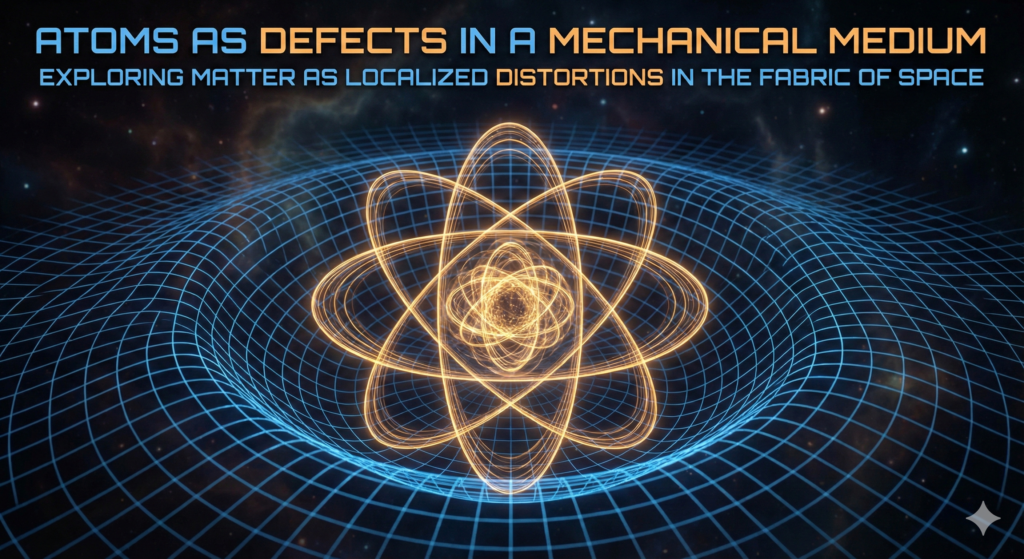
After rebuilding atomic structure from first mechanics, an obvious question remains:
If atoms are defects in a mechanical medium, why does quantum mechanics work so well?
This is not a rhetorical question.
Quantum mechanics is extraordinarily successful. Any mechanical reinterpretation that dismisses it would fail immediately.
The correct conclusion is more subtle:
Quantum mechanics is right about the states—but silent about the mechanism.
Quantum Mechanics as a Map, Not a Machine
Quantum mechanics does not tell us what atoms are.
It tells us which configurations are allowed, forbidden, or unstable.
Its mathematics is a remarkably accurate catalog of admissible states.
From a mechanical perspective:
- the wavefunction does not describe a physical wave,
- it encodes the constraints imposed by the medium,
- and it assigns weights to accessible configurations.
Quantum mechanics maps the terrain.
It does not build the terrain.
Why the Wavefunction Is So Effective
The wavefunction succeeds because it:
- respects continuity,
- enforces boundary conditions,
- and captures nodal structure precisely.
All of these are mechanical facts.
What appears as “probability” reflects:
- incomplete access to the medium’s degrees of freedom,
- sensitivity to perturbations,
- and constraint-based admissibility rather than randomness.
The wavefunction works because constraints are real.
Why Measurement Appears Special
In this framework, measurement is not mystical.
A measurement:
- forces a defect into strong coupling with an external system,
- pushes the configuration out of its transparent regime,
- and drives it toward a stable admissible state.
The so-called “collapse” is simply:
- loss of metastability,
- enforced reconfiguration,
- and rapid stress redistribution.
No observer-dependent physics is required.
Why Probabilities Appear Fundamental
Quantum probabilities are often treated as irreducible.
Mechanically, they arise because:
- many micro-configurations correspond to the same admissible macro-state,
- the medium enforces constraints globally,
- but local outcomes depend on uncontrollable details.
Probability reflects degeneracy of constraint satisfaction, not indeterminism.
Why Nonlocal Correlations Exist Without Signaling
Entanglement is one of quantum mechanics’ most unsettling features.
But mechanically, it fits naturally:
- defects embedded in the same medium must satisfy global constraints,
- changes are enforced by consistency, not signals,
- no information propagates faster than waves.
Correlations arise because the system must remain self-consistent—not because anything is transmitted.
This distinction is developed in detail in Why Entanglement Is Not Information Why_Entanglement_Is_Not_Informa….
What Quantum Mechanics Does Not Explain
Quantum mechanics does not explain:
- why states exist at all,
- why only certain configurations are allowed,
- why defects are stable,
- or why the medium enforces these rules.
It assumes the structure it so accurately describes.
The mechanical framework supplies what quantum mechanics omits: ontology.
A Clean Division of Labor
We can now say something precise and respectful:
Quantum mechanics correctly describes the allowed states of matter.
Mechanical medium theory explains why those states exist.
There is no conflict here.
There is a hierarchy.
Why This Matters Going Forward
With this understanding:
- quantum rules stop being axioms,
- paradoxes dissolve into regime transitions,
- and “weirdness” becomes constrained mechanics.
This does not weaken quantum mechanics.
It grounds it.
Key Takeaway
Quantum mechanics is a phenomenological map of admissible defect configurations—not a fundamental description of reality itself.
It works because the medium enforces strict constraints.
It appears probabilistic because we cannot track every degree of freedom.
It seems nonlocal because constraints are global.
With Series IX complete, the ontology is now clear.
From here on, we are no longer asking what matter is.
We are ready to do the harder—and more powerful—work:
recomputing physics itself from first mechanics.