Tesla’s π⁄2·c Insight Revisited
SERIES IV — ELECTROMAGNETISM, MODES & CONSTRAINTS
Fields as Stress–Flow
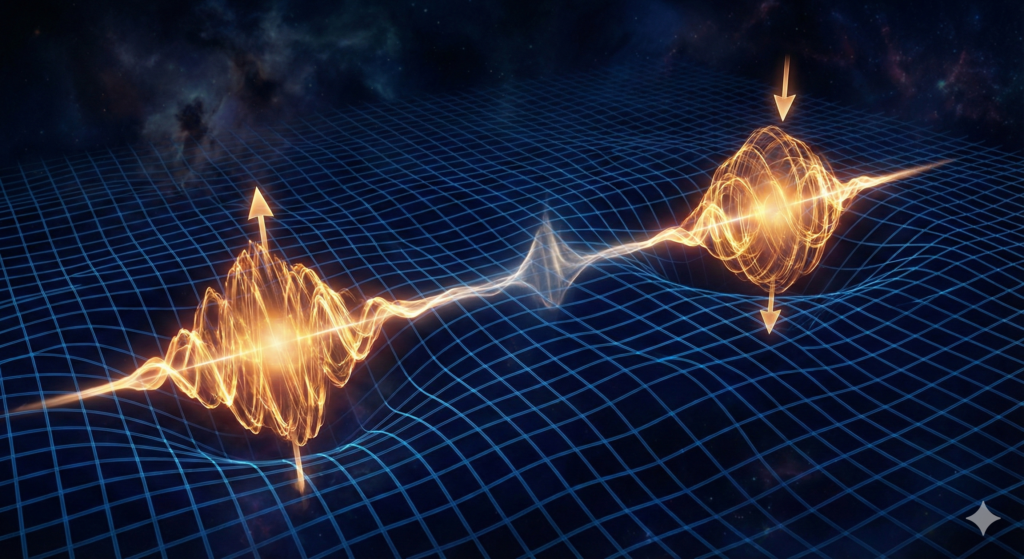
Nikola Tesla is often invoked in discussions of unconventional physics, frequently without precision and almost always without restraint. Among the many claims attributed to him is a curious one: that certain disturbances propagate not at the speed of light, c, but in relation to it—often summarized as π⁄2·c.
Taken literally, this sounds like numerology. Taken mechanically, it points to something far more modest and far more interesting:
Tesla was not proposing a new speed limit—he was gesturing toward a phase relationship between different modes of propagation.
This post revisits that idea carefully, without mythology, and places it where it belongs: in the physics of waves and constraints.
Speeds vs. Phases
The first clarification is essential.
A speed describes how fast energy or information propagates.
A phase relationship describes how different components of a wave relate geometrically.
Confusing the two leads to unnecessary paradoxes.
In wave mechanics, it is common for:
- transverse and longitudinal responses,
- displacement and restoring force,
- motion and constraint
to be out of phase by fixed geometric factors—often involving π⁄2.
This is not exotic. It is standard.
Longitudinal vs. Transverse Responses
In elastic media, two fundamentally different responses coexist:
- Transverse (shear) waves, which carry energy sideways and propagate at a speed set by shear stiffness.
- Longitudinal (compressive) responses, which enforce continuity and propagate constraints through the medium.
Longitudinal responses are not always energy-carrying waves. In nearly incompressible media, they act more like instantaneous constraint fields—ensuring that the medium remains continuous.
They define what motions are allowed, not how energy flows.
Where π⁄2 Comes From
In oscillatory systems, a π⁄2 phase offset appears whenever:
- displacement and restoring force are orthogonal,
- velocity peaks where displacement is zero,
- constraint and motion are complementary.
For example:
- In a simple harmonic oscillator, velocity is π⁄2 out of phase with displacement.
- In electromagnetic waves, electric and magnetic components are π⁄2 out of phase in certain formulations.
- In elastic systems, shear motion and compressive response are often quadrature-related.
Tesla’s π⁄2 was not arbitrary. It is the geometric signature of orthogonal modes interacting.
Tesla’s Real Intuition
Tesla consistently emphasized:
- longitudinal disturbances,
- impulses rather than steady waves,
- global coordination rather than local oscillation.
He lacked the language of modern continuum mechanics, but his intuition aligned with a real distinction: not all field responses transport energy in the same way.
Some enforce constraints.
Interpreted this way, Tesla’s statements cease to be claims about superluminal signals and become observations about how fast constraints are satisfied compared to how energy propagates.
Why This Does Not Violate Causality
Constraint propagation is not signal propagation.
When you push on one end of a rigid rod, the rod does not transmit a signal faster than sound. It enforces continuity through internal stress. No information is sent independently of the system’s structure.
Similarly, longitudinal constraint fields:
- do not carry information,
- do not transmit energy independently,
- and cannot be modulated to send messages.
They simply ensure that motion remains consistent.
Causality remains intact.
A Historical Misreading
Tesla’s reputation suffered not because his intuitions were wrong, but because they were over-interpreted.
Without a mechanical framework, later readers treated phase relationships as speed claims, and constraint behavior as energy transport.
This blog avoids that mistake deliberately.
Tesla does not need to be rescued as a prophet.
He needs to be understood as an engineer thinking in modes.
What This Does—and Does Not—Claim
This post does not claim:
- that signals propagate faster than light,
- that Tesla discovered hidden speeds,
- or that modern electromagnetism is incomplete.
It does claim:
- that longitudinal responses exist,
- that they behave differently from transverse waves,
- and that Tesla’s π⁄2 intuition reflects phase geometry, not velocity.
Why This Matters
Recognizing the difference between energy transport and constraint enforcement:
- removes confusion around “instantaneous” effects,
- clarifies Tesla’s language,
- and prepares us to address one of the most misunderstood phenomena in modern physics.
In the next post, we examine longitudinal responses directly—and explain why their exclusion from standard field theory was a modeling choice, not a physical necessity.
Next:
→ Longitudinal Waves Are Not Forbidden