
The Speed of Light Is the Speed of Sound (Kind of)
SERIES II — GRAVITY & RELATIVITY
Stress, Not Curvature
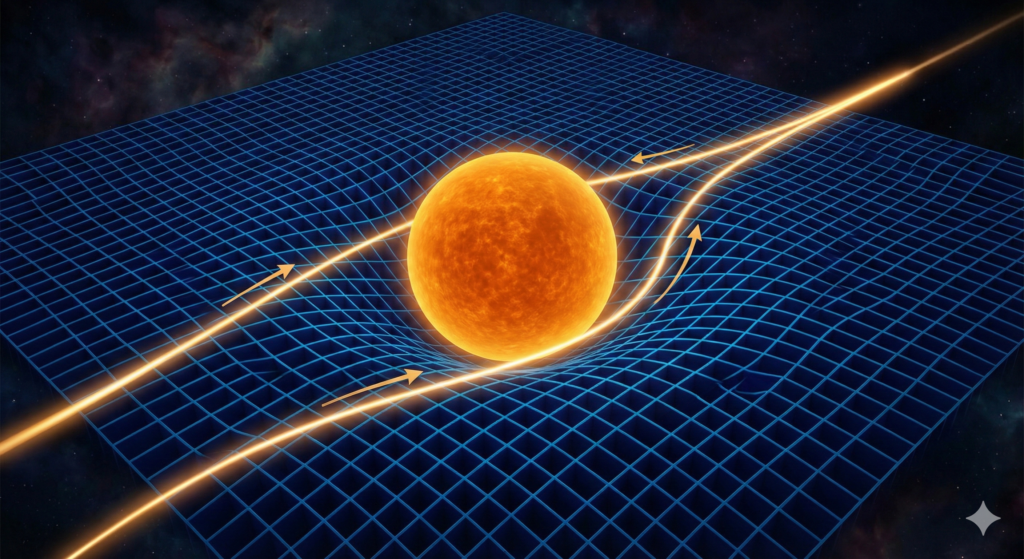
Few numbers in physics are treated with as much reverence as the speed of light. It appears everywhere—relativity, electromagnetism, causality—and is often presented as a fundamental limit with no deeper explanation.
This post makes a quieter claim:
The speed of light behaves exactly like a wave speed set by material properties.
Not metaphorically. Mechanically.
What Sets a Wave’s Speed?
In every physical medium we understand, wave speed is not arbitrary. It is determined by how strongly the medium resists deformation and how much inertia must be moved in the process.
For transverse (shear) waves, the rule is universal:
wave speed = √(shear stiffness / density)
This relationship holds for:
- elastic solids,
- seismic shear waves,
- engineered materials,
- and any medium that supports transverse motion.
It is not a modeling choice. It is a mechanical consequence.
Why This Sounds Uncomfortable
We are taught that light needs no medium, while sound does. Sound is “mechanical”; light is “fundamental.” As a result, comparing their speeds feels category-breaking.
But notice what the comparison actually says.
Calling light’s speed the “speed of sound” does not mean:
- light is an acoustic vibration,
- the vacuum behaves like air,
- or that light requires collisions of particles.
It means something much more precise:
Light propagates at the characteristic transverse wave speed of the medium that supports it.
If light is a shear wave—as established earlier—then this conclusion follows automatically.
Why the Speed Is the Same Everywhere
One of the triumphs of relativity is the observation that the speed of light is invariant for all inertial observers. This invariance is often taken to rule out any medium.
But invariance does not require emptiness. It requires uniform constitutive properties.
In a homogeneous medium:
- wave speed is the same everywhere,
- observers moving uniformly with respect to the medium measure the same local speed,
- transformations preserve the wave speed by construction.
This is exactly how wave propagation works in elastic continua.
The mathematics of Albert Einstein formalized this invariance brilliantly. What it did not specify was why the invariant speed exists.
Why the Speed Is So High
If the vacuum’s shear stiffness is enormous and its effective density is extremely low, the resulting wave speed will be extremely large.
Nothing exotic is required.
Engineers routinely encounter materials where:
- small stiffness changes produce large speed differences,
- wave speeds vary by orders of magnitude across materials.
The vacuum simply occupies an extreme corner of this parameter space.
Gravity as a Speed Modifier
In the previous post, we argued that gravity acts primarily through stiffness gradients.
This has an immediate consequence:
if stiffness varies with position, wave speed must vary too.
In optics, this produces refraction.
In gravity, it produces:
- light bending,
- time dilation,
- signal delay near massive objects.
From a mechanical perspective, these effects arise because waves slow slightly in regions where the medium responds more easily to deformation.
The speed of light remains locally fixed—but the medium is not uniform.
Why This Does Not Break Relativity
This perspective does not violate:
- Lorentz invariance,
- experimental tests of relativity,
- or the constancy of local light speed.
It simply interprets that invariance as a property of a medium rather than as an axiom without cause.
Relativity tells us how measurements transform.
Mechanics tells us what is being transformed.
The two are compatible.
A Historical Echo
Long before modern field theory, James Clerk Maxwell noted that electromagnetic waves propagate at a speed determined by electric and magnetic constants—quantities that behave like elastic parameters. He recognized the resemblance but lacked the tools to formalize a mechanical substrate.
The resemblance was not accidental.
What This Reframing Achieves
Understanding light speed as a material wave speed:
- removes its mystical status without diminishing its importance,
- unifies light with other wave phenomena,
- explains why speed enters gravity and relativity naturally,
- and sets the stage for a non-geometric view of time effects.
In the next post, we confront those time effects directly—and show that they require no moving clocks through abstract spacetime.
Next:
→ Relativity Without Time Travel